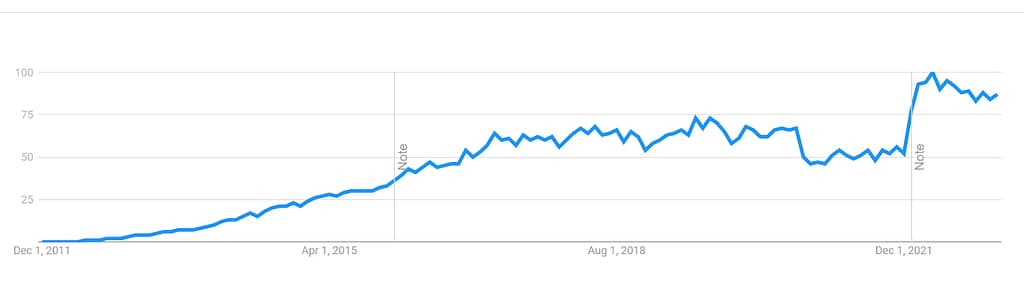
Laravel is a free and open source framework for creating both personal projects, such as blogs, and enterprise-level sites for large companies. Its popularity is growing globally year by year.
In this post we’ll consider why building an eCommerce project from scratch using Laravel is rational.
What Is Laravel?
Laravel is an open source PHP framework specially designed for building complex apps and websites. The framework makes it possible to simplify authentication, routing, sessions, caching, application architecture and database work, which leads to a reduction in the time for the implementation of MVP and the launch of the project.
It was developed in 2011 and further maintained by Taylor Otwell in his attempt to produce a more feature-rich alternative to the CodeIgniter framework. Laravel architecture pattern is majorly based on Symfony. Laravel is written in PHP and is used to develop apps based on the MVC pattern. MVC (Model – View – Controller) is a scheme for distinguishing application data and control logic into three separate components: model, view, and controller. Modification of each component under such a scheme is carried out independently, which simplifies the study and rapid creation of application prototypes. Many consider Laravel to be one of the most popular MVC frameworks.
Companies That Use Laravel
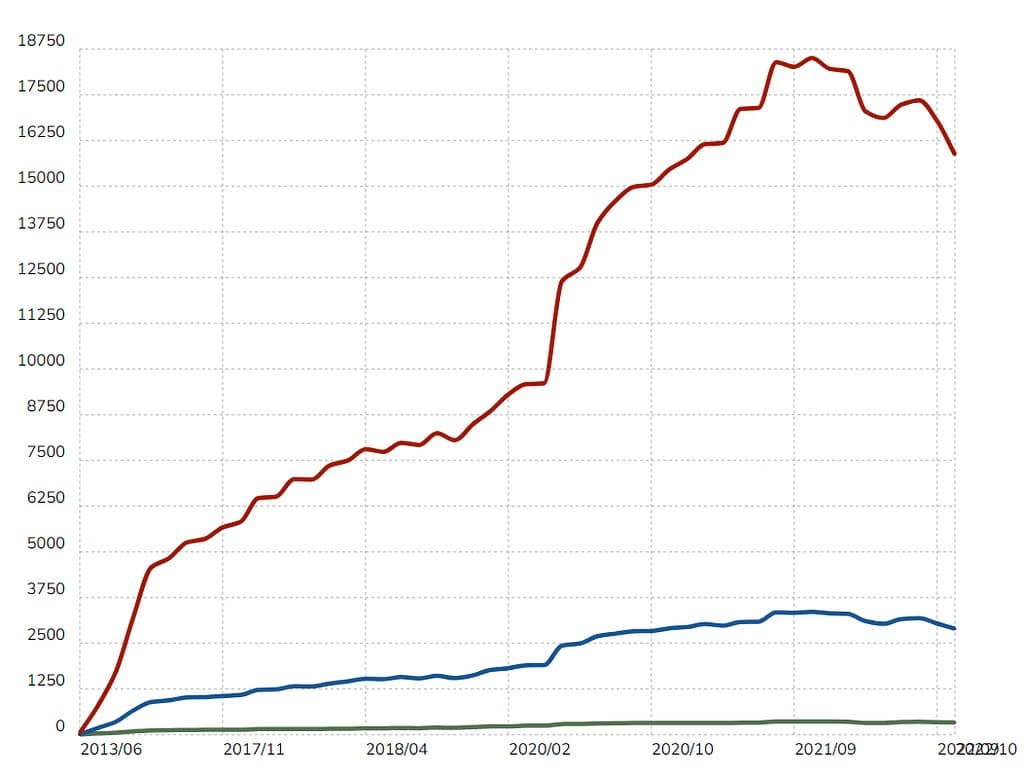
Laravel is widely used by absolutely different companies both for the back- and frontend purposes. The list of businesses using it is endless. Let’s just mention such names as:
- Pfizer, the largest pharmaceutical company
- BBC, the oldest broadcasting organization
- Liberty Mutual Insurance, a well-known insurance company from the US
- Ratio, an innovative Fintech software company from the UK
- About You, a fast-growing eCommerce site from Germany that allows customers to access over 150,000 products available on their platform
- TourRadar, an international travel company that offers booking and marketing solutions for hotels and tour operators
What Is Laravel Used For?
Laravel suits a variety of apps: be it a CMS, an eCommerce site or an ERP system. With Laravel, you can not only implement a standalone system, but also develop a separate part – a subsystem, which in the future can be integrated into the whole project. For example: you can create an accounting system or an order cost calculator.
Look at the software list where Laravel was used to build a part of the system, namely, the reporting subsystem:
- Invoice Ninja – an invoicing and billing software that uses Laravel as its primary framework. It has a reporting system that allows users to generate reports based on various parameters, such as clients, invoices, payments, etc.
- Snipe-IT – an IT asset management system that leverages Laravel as its backend framework. It has a comprehensive reporting system that enables users to generate reports on assets, licenses, warranties, and more.
- CMS Airship – a content management system that uses Laravel in a powerful, organized, and secure platform for building and managing websites. It has a reporting system that allows users to analyze visitors’ behavior, track page views, and track sales.
There are several online stores with price calculators on Laravel available on the internet, which assist in offering personalized quotes in real-time to clients. These calculators enable customers to select product configurations, shipping options, and additional features before making a purchase. These websites use Laravel as the backend that handles all the business logic involved in calculating and displaying the price.
Here are some examples of Laravel-based online stores with price calculators that may be of interest:
- PrintPlace, a store providing online printing services with printing calculators
- FineAwards, custom awards, trophies and plaques with price calculator
- UPrinting, store offering customizing and printing professional marketing materials, stickers, labels, pacing, and promo products
- Raymour & Flanigan furniture store with their own room planner
Why Use Laravel Framework For Web App Development?
What’s the point of Laravel for web developers? There is a number of benefits:
- MVC architecture. This allows you to separate the presentation and the logic of the application and, ultimately, to develop new applications and their components faster.
- Automatic testing. This ensures that the application updates will not affect its functionality.
- Fast integration. Laravel easily integrates via API with other convenient tools, expanding its capabilities. You can connect, for example, Redis, a caching system, to the framework, which will allow you to configure the storage of cached files on the server and, ultimately, increase the performance of the application.
- Security and vulnerability protection. Laravel is considered one of the secure PHP frameworks. Laravel technology itself helps protect applications from common hacks such as SQL injection, cross-site queries, and cross-site scripting.
- Efficient user authorization and authentication logic. Laravel has all the settings to control user access to the application depending on the role in the project.
- Mail server and sending notifications to users by mail. Laravel provides default servers such as SMTP, Sendmail, and Spart Post. They allow you to send notifications through local and cloud services, which is very convenient.
- Command scheduler. It can be used to efficiently schedule emails to be sent to all users or clean up spreadsheets at the end of the day.
Top 10 Laravel Features That Make It Popular
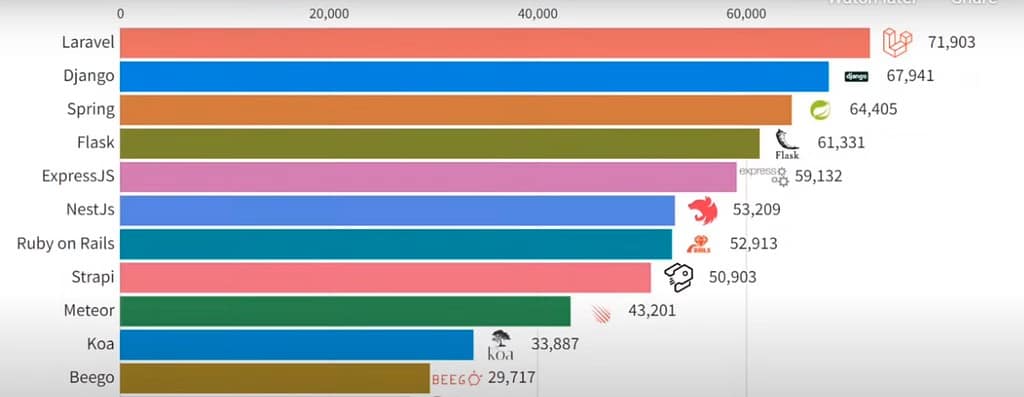
Laravel has retained its rather high position in the top frameworks thanks to its great features. The release of version 3 brought the popularity to the framework with such features as Artisan, the Command Line Interface, support for the database system and migrations. Since then, Laravel has obtained the following features:
- URL routing: feature allows showing all the link’s contents within the current webpage without redirecting to the link. The user doesn’t have to wait for the page loading to view the link content.
- Eloquent ORM. The object-relational mapping feature offers a great syntax facilitating the users’ work with database objects and relationships.
- Message queue system, a feature that helps users run tasks in the background and not to overload the system.
- IoC Container. It helps handle class dependencies automatically, without configuration.
- Template engine allows creating layouts with dynamic content. Users can insert a finished widget with the help of CSS and JS codes.
- Artisan, a command line that enhances performance excluding repetitive tasks. Programmers, for example, can create database structures with a built-in skeleton code and save time and efforts
- Pre-installed libraries including the object-oriented ones that make the coding process easier for developers.
- Database seeding is used for populating database tables with the chosen data used on the application testing.
- Migration tools to create indices, tables, and databases
- Support of multiple file systems, both cloud and local, like Amazon S3, for example.
The Popularity of Laravel Over Other PHP Frameworks
There is no perfect framework for software development. Choosing the right technology stack will depend only on your project requirements and needs. Let’s compare Laravel with some of its main competitors:
Laravel vs PHP
Laravel is actually a PHP web application framework. It is built on top of the PHP programming language, providing developers with a set of tools and resources that make it easier to build web applications quickly and efficiently. PHP, on the other hand, is a scripting language which is used to create dynamic content on the web.
Essentially, Laravel is an extension of PHP that provides additional functionality, making it easier to write clean, scalable, and maintainable code. It provides a number of features out of the box, such as built-in user authentication and routing.
Yii2
Yii2 is a modern web app framework on PHP. It has a modular architecture, which gives developers the flexibility to choose the components they need for their project. Some of the features of Yii2 include caching and RESTful API. However, there are some differences that set Laravel apart from Yii2:
- Laravel has a more intuitive syntax than Yii2
- Laravel has a more powerful ORM than Yii2
- Laravel offers more out-of-the-box functionality than Yii2
- Laravel has a faster development cycle than Yii2
- Laravel offers better security features than Yii2
Symfony
Symfony includes a number of reusable PHP libraries. Thanks to its scalability, it suits better complex projects. The Symfony advanced tools and features simplifies modification into Java or C#. Although Symfony consumes less memory and is faster, programmers state that it is harder to learn it.
CodeIgniter
It better fits simple and scalable web app development. CodeIgniter is a minimalist framework assisting lightweight PHP developers. CodeIgniter has faster performance, but as compared to Laravel, it is less robust and has more limitations.
Laravel Advantages And Disadvantages
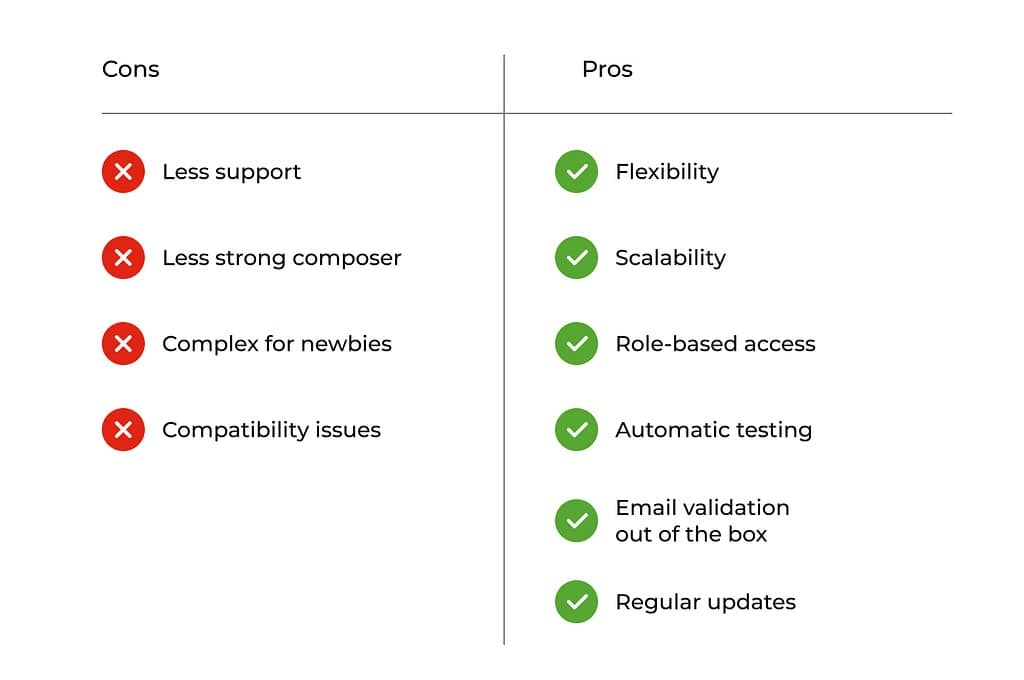
Let’s start with the cons as the advantages have been told a lot before.
Disadvantages:
- It has less inbuilt support when compared to other frameworks like Django or Ruby on Rails.
- Laravel’s composer is less strong as compared to other web frameworks.
- Many methods involved in reverse routing are complex for newbies.
- Compatibility issues: as Laravel constantly evolves, it may have compatibility issues with previous versions, which can create issues for developers.
Advantages:
Despite all these drawbacks, it is still a popular framework thanks to the following pros:
- Flexibility
- Scalability
- Role-based access
- Automatic testing
- Email validation out of the box: the developer does not need to spend time creating this useful email verification tool functionality to keep email protected for new users of the application.
- Regular updates that remove accumulated vulnerabilities
Popular Combinations in Laravel
Laravel is also appreciated for its ability to combine with other frameworks. By combining frameworks, you can apply the power of both. Let’s examine some examples:
- Laravel plus Vue: VueJS allows the Laravel devs to create new frontends without reloading the pages every time the application is updated. Besides, this combination helps handle updates effectively thanks to virtual DOM in Vue that instantly responds to pages without loading the app performance.
- Laravel plus Angular: the latter provides developers with enhanced performance, better frontend and responsiveness to the user in terms of feedback.
The Future of Laravel Web Development in 2023 and Coming Years
Web apps and sites built on Laravel evolve rapidly together with the technology. In future, we’ll see more sites with:
- IoT (Internet of Things) integration
- Better user interface and micro-frontends
- Chatbots
- Blockchain innovation
- Hashed text
Conclusion
Laravel is an excellent framework for building highly customized web applications. If your project requires unique business logic, custom workflows, or software that extends beyond eCommerce, developing with Laravel can be the right long-term investment.
However, if your goal is to launch an online store, B2B portal, or multi-vendor marketplace, building every eCommerce feature from scratch is rarely the most cost-effective approach. Product catalogs, checkout, payments, order management, promotions, SEO tools, customer accounts, and hundreds of other commerce capabilities have already been solved by specialized eCommerce platforms.
Instead of spending months recreating these core features in Laravel, you can start with CS-Cart and customize only the functionality that makes your business unique. This significantly reduces development time, lowers project costs, and gives you a production-ready commerce platform that can continue evolving as your business grows.
Frequently Asked Questions About Laravel
What is included in the Laravel ecosystem?
The Laravel ecosystem includes tools such as Forge, Envoyer, Mix, Cashier, Telescope, Horizon, and Valet for deployment, debugging, asset management, payments, queue management, and local development.
How do you use Laravel?
Install PHP, Composer, and a database, create a new project with Composer, then use Laravel’s Artisan CLI to build routes, controllers, models, and views.
What are the new features in Laravel 10?
Laravel 10 introduced PHP 8.1 support, Laravel Pennant, improved validation rules, and enhanced type declarations.
What is the current version of Laravel?
Laravel 10 is the latest major version covered in this article, released in February 2023.
What types of projects is Laravel best suited for?
Laravel is ideal for custom web applications, enterprise systems, high-load platforms, Big Data processing, and projects requiring long-term scalability.
Can Laravel be used to build an eCommerce website?
Yes, but unlike dedicated eCommerce platforms, all core commerce features must be developed or integrated from scratch.
Should I choose Laravel or an eCommerce platform like CS-Cart?
Choose Laravel for highly customized applications, and choose CS-Cart if you want to launch an online store or marketplace faster with built-in commerce functionality.
Can Laravel be used for mobile app development?
Yes, Laravel is commonly used to build APIs and backends that power native or cross-platform mobile applications.
Can Laravel be used to create chatbots?
Yes, Laravel can serve as the backend for chatbots by integrating with messaging platforms and AI or automation services.

eCommerce expert with 10+ years of experience in marketplace management and consumer behavior. Gayane tracks the latest industry trends to provide businesses with analytical, actionable insights.