Starting an online marketplace is easier today than ever before. Entrepreneurs can launch marketplace MVPs using ready-made marketplace software, validate demand before investing heavily in development, and scale the platform as buyer and seller activity grows.
To build a successful marketplace, you need to validate your idea, choose the right business model, select marketplace software, attract sellers and buyers, and continuously improve the platform based on real-world feedback.
Marketplaces have become the dominant eCommerce model because they scale differently from traditional online stores. Unlike retailers that must purchase, store, and manage inventory, marketplace operators can grow through an asset-light business model that relies on third-party sellers.
Instead of relying on a single seller and inventory source, marketplaces grow by connecting buyers and sellers through a shared platform. As more participants join, network effects increase the value of the marketplace, allowing operators to expand product selection, generate multiple revenue streams, and grow without managing inventory directly.
So, what does it take to build a successful online marketplace in 2026? Let’s break the process down step by step.
– Successful marketplaces in 2026 focus on niche positioning, strong user experience, marketplace automation, AI-powered operations, and scalable vendor ecosystems.
– Platforms like CS-Cart help businesses launch marketplace MVPs quickly and scale with vendor management tools, split payment integrations, automation, and open-code flexibility.
What is an Online Marketplace?
An online marketplace is a platform that connects multiple buyers and sellers and facilitates transactions between them.
Unlike a traditional online store, which is operated by a single seller offering their own inventory, a marketplace acts as a facilitator or intermediary that hosts many sellers under one roof, providing a wide assortment of goods and services from different sources.
For entrepreneurs wondering how to create an eCommerce marketplace, the process usually begins with validating demand, selecting a marketplace business model, choosing marketplace software, and launching an MVP before investing in large-scale development.
Online Store vs Online Marketplace
| Online Store | Online Marketplace |
|---|---|
| One seller | Multiple sellers |
| Own inventory | Third-party inventory |
| Single revenue source | Multiple revenue streams |
| Limited assortment | Large product selection |
| Merchant manages products | Vendors manage products |
How Does an Online Marketplace Work?
An online marketplace operates as a platform that connects multiple independent sellers with buyers through a single website or application. Unlike a traditional online store where one company owns and sells all products, a marketplace acts as an intermediary that facilitates transactions, manages interactions between participants, and provides the infrastructure required for commerce. This model is one of the main reasons why starting an online marketplace has become an attractive option for entrepreneurs looking to scale without managing inventory directly.
A typical marketplace transaction involves several participants. Sellers list products or services, buyers browse and place orders, the marketplace platform processes payments, and the marketplace owner earns revenue through commissions, subscriptions, listing fees, or other monetization models.
Behind the scenes, the marketplace coordinates product catalogs, user accounts, order management, payment processing, vendor payouts, inventory synchronization, customer communication, and analytics.
Multi-Vendor Marketplace Architecture
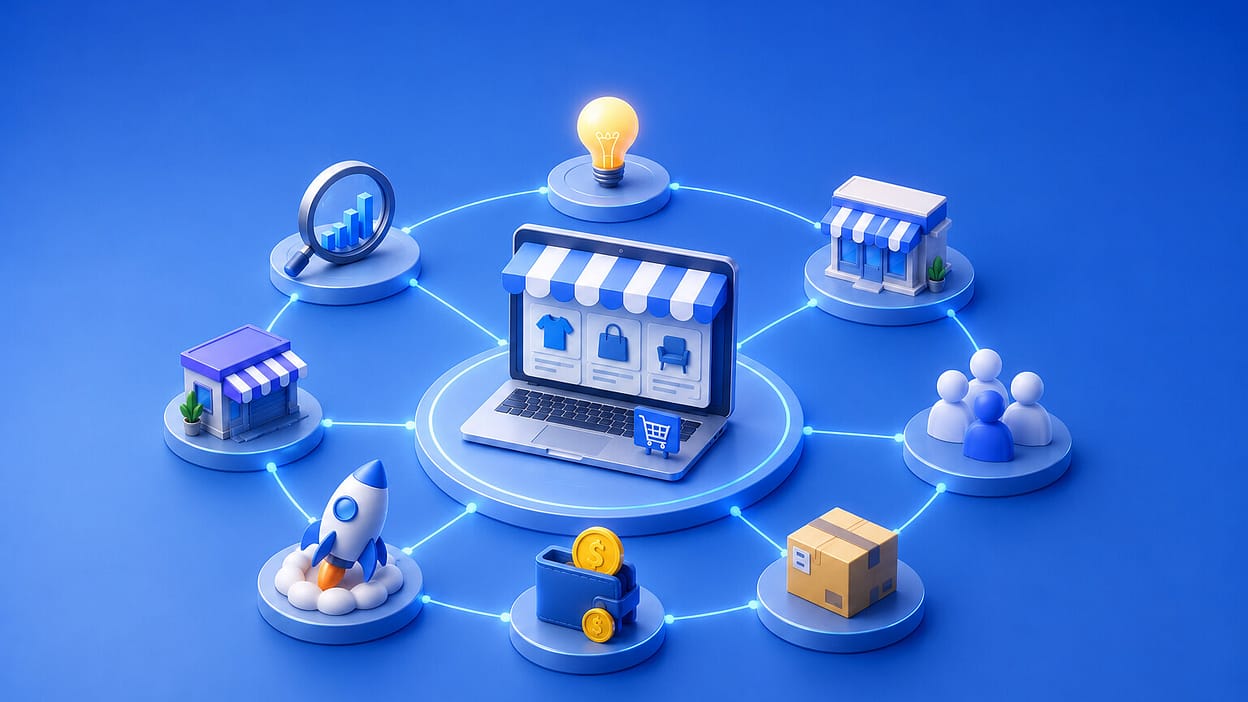
A multi-vendor marketplace architecture is the foundation of any modern marketplace platform. It enables multiple independent vendors to operate within a shared ecosystem while allowing the marketplace owner to maintain centralized control.
Most marketplace architectures consist of three core participant groups:
Marketplace administrator. The platform owner manages marketplace rules, commissions, seller approvals, payments, categories, content moderation, and overall platform operations.
Vendors. Each seller manages their own products, inventory, pricing, fulfillment, and customer interactions through a dedicated vendor dashboard.
Buyers. Customers browse products from multiple vendors, compare offers, place orders, leave reviews, and communicate with sellers through a unified shopping experience.
When a customer places an order, the marketplace software automatically routes order information to the appropriate vendors, calculates commissions, processes payments, and records transaction data. In marketplaces that support split payments, the platform can automatically distribute funds between the marketplace operator and participating vendors without manual intervention.
As more sellers join the platform, the marketplace expands its catalog and value proposition without proportionally increasing operational costs.
Core Marketplace Infrastructure
While users only see the storefront, every successful marketplace relies on a complex infrastructure working behind the scenes.
At the center of this infrastructure is the marketplace software, which serves as the operational hub connecting buyers, sellers, payments, and platform administration.
Core marketplace infrastructure typically includes:
- Vendor management system for seller onboarding, verification, approvals, and performance tracking.
- Product and inventory management tools that allow vendors to maintain accurate catalogs and stock levels.
- Order management system that coordinates purchases involving one or multiple sellers.
- Payment infrastructure that supports payment gateways, split payments, automated payouts, refunds, and transaction monitoring.
- Customer management tools for communication, reviews, support requests, and loyalty programs.
- Analytics and reporting systems that help operators monitor GMV, revenue, conversion rates, vendor performance, and marketplace liquidity.
- Integration layer that connects the marketplace with ERP, CRM, shipping, accounting, tax, and marketing platforms.
As a marketplace grows, infrastructure becomes increasingly important. Platforms must handle larger product catalogs, more vendors, higher transaction volumes, and expanding customer bases without sacrificing performance. This is why marketplace scalability should be considered from the very beginning rather than after growth has already started.
Why Create an Online Marketplace?
Launching an online marketplace can be a highly scalable business model because it benefits from network effects. Every new seller expands the available selection, while every new buyer creates additional sales opportunities for vendors. As participation grows on both sides, the marketplace becomes increasingly valuable to everyone involved.
Marketplace owners do not need to purchase, store, or manage inventory themselves, which reduces operational complexity and allows the business to scale more efficiently.
Marketplaces also benefit from multiple revenue streams, including commissions, subscriptions, listing fees, and advertising. Combined with access to valuable customer and transaction data, this creates a flexible business model that can adapt and grow over time.
Whether you’re launching a niche marketplace, building a B2B platform, or creating a marketplace similar to Etsy, Fiverr, or Airbnb, success depends on more than technology alone. You need a validated business model, sufficient marketplace liquidity, a clear value proposition, and a scalable platform that can support future growth.
Today, entrepreneurs can choose between ready-made marketplace software and custom development. Most founders start with a marketplace MVP built on existing software, validate demand, and gradually expand functionality as the business grows. This approach reduces risk, shortens time to market, and helps avoid unnecessary development costs during the early stages by utilizing specialized growth navigate startup tools to audit infrastructure expenses and maintain capital efficiency.
This guide walks through the key stages of marketplace development—from validating an idea and choosing a business model to launching an MVP, attracting users, and scaling the platform. Whether you’re building your first marketplace or expanding an existing business, these steps will help you reduce risk and accelerate growth.
In this guide, we will teach you the essentials of marketplace website building: how to create a successful marketplace website from the ground up using one concise software. Ensure you follow these steps, adapting them to your specific circumstances.
The fastest way to build a marketplace website today is to start with ready-made marketplace software, validate demand with an MVP, and gradually scale functionality as the business grows.Marketplace Business Models
Before building a marketplace, it is important to understand how the platform will generate revenue. Most marketplace business models rely on one or several monetization strategies.
The most common marketplace monetization models include:
- Commission model — charging a percentage of every transaction.
- Subscription revenue — recurring monthly or annual vendor fees.
- Listing fees — charging sellers for publishing products or services.
- Advertising and promoted listings — paid visibility inside the marketplace.
- Freemium model — basic access for free with premium features available as paid upgrades.
Read more: Navigating Marketplace Business Models: A Comprehensive Guide for Entrepreneurs
10 Crucial Things to Keep in Mind before Building a Marketplace

Launching a marketplace involves more than choosing software and attracting users. Long-term success depends on validating demand, building trust, selecting scalable technology, and creating a sustainable business model. Before you start building, consider the following factors that can significantly influence marketplace growth and profitability.
Thing #1: Thorough Market Research. Before creating a marketplace website, conduct a comprehensive market study. Understand the particular niche you’re targeting, analyze competitors, and identify potential challenges, including user pain points and timing patterns. Modern research tools, including AI-powered market intelligence platforms, can help identify demand patterns, emerging niches, and underserved customer segments faster than traditional research methods alone. A clear understanding of these demand patterns is especially important in niches with seasonal or cyclical user behavior. Understanding these demand patterns helps any marketplace tailor features to real user needs. This groundwork will provide insights into marketplace business models, help you tailor your platform development approach to meet business requirements, define the marketplace’s brand identity, and successfully create an online marketplace.
Thing #2: Clear Value Proposition. Before launching an online marketplace, define a clear and compelling value proposition for your platform. Identify what sets your platform apart from others and how it addresses the pain points of your target audience and how well it fits your target market. A strong value proposition (UVP) should clearly explain why sellers should join your platform instead of competitors and why buyers should choose your marketplace over alternative purchasing channels.
Thing #3: User-Friendly Design. The success of an online marketplace website hinges on user experience and effective UX/UI design. Responsive design, an intuitive and user-friendly interface that simplifies navigation for both sellers and buyers. The experience should be optimized not only for buyers but also for sellers. Fast onboarding, intuitive vendor dashboards, mobile accessibility, and streamlined product management tools are equally important for marketplace adoption. Ensure that the platform is accessible across various devices to cater to a broader audience, including through a marketplace mobile app that improves convenience and user engagement. Marketplace building requires a balance between user experience, vendor tools, and scalable technology.
Thing #4: Robust Security Measures. Security is paramount in eCommerce platforms, considering the sensitive nature of transactions and personal information. Implement robust security measures, including secure payment processing gateways, data encryption, fraud detection and protection against fraud. Many marketplaces also implement seller verification, identity checks, account protection mechanisms, and AI-assisted fraud detection to reduce risk and improve trust across the platform. Convince users to trust your marketplace business by prioritizing their privacy and security.
Thing #5: Scalability and Flexibility. Anticipate the future growth of your marketplace website and build a marketplace that can accommodate an increasing number of users and transactions. Whether you use ready-made software or custom code, your eCommerce marketplace development approach should support future scalability. Marketplace website development requires flexibility in the platform and its code, ensuring adaptability to evolving market changes and technological innovations. In practice, how much does it cost to start a marketplace depends heavily on the chosen development approach, customization level, integrations, and future scalability requirements. While custom development offers maximum flexibility, many modern marketplace platforms provide extensive customization, integrations, and scalability without requiring a complete custom build from day one.
Thing #6: Legal Basis. Before you make a marketplace, familiarize yourself with the legal requirements and regulations pertaining to ecommerce platforms, especially to online marketplaces, in your target market region. Address issues such as user data protection, taxation, and regulatory compliance with eСommerce laws to avoid future legal complications.
Thing #7: Marketing Strategy. Many successful marketplaces combine human support with self-service resources such as knowledge bases, automated workflows, AI assistants, and vendor help centers to improve response times and reduce operational costs.
Read more: Marketplace Marketing Strategy: A Practical Guide to Growth and Liquidity
Thing #8: Transparent Policies. Establish clear and transparent policies for both buyers and sellers. Clearly define terms of service, fees, and dispute resolution mechanisms. Transparent policies build trust among users and contribute to the overall success of your online marketplace. As marketplaces grow, marketplace governance becomes increasingly important. Governance includes moderation policies, seller verification procedures, dispute resolution mechanisms, content standards, and fraud prevention rules. Strong governance helps maintain trust between buyers and sellers while protecting the reputation of the platform.
Thing #9: Customer Support. Prioritize excellent customer support to address queries, concerns, and issues promptly. A responsive customer support system enhances user satisfaction and contributes to the overall success of online marketplaces.
Thing #10: Analytics and Monitoring. Implement robust analytics tools to track user behavior, monitor performance, and gather valuable insights. Utilize data-driven decisions to optimize your online marketplace website, enhance user experience, and stay ahead of online marketplaces trends.
Marketplace analytics provide visibility into critical business metrics such as Gross Merchandise Value (GMV), vendor performance, customer acquisition costs, conversion rates, retention, and marketplace liquidity. These insights help operators identify growth opportunities and make informed strategic decisions.
By carefully considering these crucial factors, you’ll lay a strong foundation for the marketplace website development lifecycle.
Building a marketplace website typically involves seven stages:
–
Validate a marketplace idea
- Research market demand
- Choose a business model
- Select marketplace software
- Launch an MVP
- Attract sellers and buyers
- Promote and scale the platform
Step #1. Invent a Marketplace Idea and Test It Before Making an Online Marketplace

Every successful marketplace starts with a validated idea. Before choosing marketplace software, defining a monetization strategy, or recruiting vendors, you need to identify a real problem that buyers and sellers are willing to pay to solve.
Every project starts with a concept, and a marketplace business is no exception. Before considering a marketplace business model, choosing the right software, or attracting more customers and vendors, you need to develop your marketplace website idea and refine it.
3 essential tips on how to come up with a good marketplace idea:
- Focus on a specific problem or underserved niche where both buyers and sellers can benefit from a dedicated marketplace.
- Find out about what your competitors do. This will help you fine-tune the marketplace idea.
- Discuss your idea with people. Listen to people’s opinions and polish your idea based on the feedback.
There’s no reason to initiate a marketplace website development if no one needs your platform. Therefore, before proceeding, you must first prove the demand.
You must prove the demand.
The next step on your way to create a marketplace is to validate the idea. You can build a marketplace that looks perfect and is super-convenient, but it will become a “desert platform” if your idea doesn’t work. Many marketplace projects failed because of it. Many entrepreneurs fail to define their online marketplace model clearly, which often leads to monetization issues later.
Marketplace founders often assume that demand exists because the idea seems attractive. In reality, many marketplace projects fail because they solve problems that are not important enough for users to change their behavior or adopt a new platform. Even the best technology and marketing cannot compensate for a weak marketplace concept. Validation helps ensure that your idea addresses a real market need before significant time and money are invested in development.

2 powerful methods on how to validate your multivendor marketplace idea:
- Conduct interviews with your potential buyers and vendors. Talking to people is the best way to learn about their needs and concerns. It’s crucial that you speak with them personally, understand the buyer’s benefits or inconveniences, ask them well-thought-out questions, and react to their answers. This is a powerful tool to test your marketplace business plan on your way to start an online marketplace.
Here in CS-Cart, we regularly conduct interviews with our customers, and we have to admit that for now, this is the best way to know a customer better. Once you have proven your idea to be viable, you can present your marketplace project to the interviewee and collect initial feedback. Before creating online marketplace infrastructure, ensure your business idea is validated and meets real market demand. - Study the search data. Use SEO tools such as Ahrefs or Semrush to learn what people are searching online globally and in your region, what keywords they use most often. Look for patterns in search demand, keyword trends, online communities, and competitor activity to understand whether interest in your marketplace niche is growing, stable, or declining.
Conduct interviews with your potential customers and vendors. In addition to interviews, many founders use landing pages, waitlists, and pre-launch campaigns to measure interest before building the marketplace itself. These methods can help validate demand and collect potential buyers and sellers before development begins.
Step #2. Find out if There’s a Market for Your Business Idea

Once you have a marketplace idea, the next step is validating whether sufficient demand exists on both sides of the marketplace. Successful marketplaces require not only interested buyers but also enough sellers willing to participate. Market research helps determine whether a sustainable marketplace ecosystem can realistically be created.
- Define your target audience: Identify who your potential customers are. Consider the following factors: demographics, interests, location, and purchasing power. This will help you focus your research efforts and tailor your marketplace website to meet their needs. Pay particular attention to buyer motivations, purchasing behavior, and the specific problems they are trying to solve. The most successful marketplaces are built around clearly defined customer pain points rather than broad audiences.
- Competitor analysis: Identify existing online marketplaces that operate in a similar space or target a similar audience. Study their offerings, pricing strategies, customer reviews, and overall market position. This analysis will help you understand the competition and identify gaps or opportunities for your marketplace website. Look beyond direct competitors. Analyze alternative solutions that customers currently use to solve the same problem, including offline channels, industry directories, social media groups, and existing marketplaces.
- Online surveys and questionnaires: Create surveys or questionnaires to gather insights directly from your potential customers. Use platforms like SurveyMonkey or Google Forms to design and distribute these surveys. Ask questions about their preferences, pain points, and willingness to use an online marketplace like yours.
- Interviews and focus groups: Conduct in-depth interviews or organize focus groups with your target audience. Engage with them to understand their needs, challenges, and expectations regarding the products or services your marketplace would offer. These qualitative insights can be valuable in shaping your online marketplace business model. Focus on understanding existing workflows, purchasing habits, frustrations, and unmet needs rather than asking users whether they would use your marketplace. People often struggle to predict future behavior, but they can accurately describe current problems.
- Community and social listening: Monitor social media platforms, forums, and online communities where your target audience is active. Pay attention to discussions, comments, and feedback related to your industry or the type of products or services you plan to offer. This will provide real-time insights into customer preferences, pain points, and market shifts.
- Keyword research: Use the right tools like Google Keyword Planner, SEMrush, or Moz to identify popular search terms and phrases related to your marketplace idea. This will give you an indication of the demand for specific products or services and help you understand what potential customers are searching for online. Keyword research can also reveal emerging marketplace opportunities, underserved niches, and seasonal demand patterns that may influence your launch strategy.
- Analyze industry reports and market data: Look for industry reports, market research studies, and data from reputable sources that pertain to your niche. These additional resources can provide valuable insights into market size, growth trends in the marketplace, and customer behavior within your industry. AI-powered market intelligence platforms can also help identify trends, estimate market potential, and monitor competitor activity more efficiently than traditional manual research alone.

Market research should not end once the marketplace launches. Continuously monitor demand, customer behavior, vendor activity, and competitive changes to identify new opportunities and adapt your marketplace strategy as the business grows.
The primary objective of market research is to confirm that enough buyers and sellers exist to create marketplace liquidity. Without sufficient demand on both sides, even a well-designed marketplace may struggle to generate transactions.
Step #3. Think Over a Business Model

Your marketplace business model determines how the platform creates value for buyers and sellers, generates revenue, and scales over time. Before launching a marketplace, you need to decide which market segment you will serve, how the platform will make money, and what type of marketplace ecosystem you want to build.
A business model for an online marketplace encompasses user experience policies, revenue models, monetization strategies, and the overall functionality of your electronic marketplace. When you build a marketplace website, focus on 4 essential things when thinking about your marketplace model.
eCommerce marketplace development typically involves business validation, marketplace architecture planning, software selection, MVP launch, vendor acquisition, payment infrastructure setup, and long-term platform scaling. The business model decisions you make at this stage will influence every part of that process.
1. Choose what marketplace business segment you will work in
There are four main segments you should look at when you plan your business model—B2C, B2B, P2P, and C2C. The segment you choose will directly influence how quickly you can achieve marketplace liquidity, attract vendors, and generate sustainable transaction volume. Note that these are not marketplace business models, these are business segments.
- B2C (Business to Customer). This is the most popular segment for now. In the B2C segment, companies sell online products or services directly to end customers. Amazon, eBay, Aliexpress, and a great number of other global online marketplaces work in the business-to-customer segment. This segment is very competitive, and choosing the right B2C eCommerce platform is often a core decision for companies selling directly to end customers.
- B2B (Business to Business). This is the second popular segment in marketplace business. In B2B, companies offer products to other companies. For example, a company that produces machine tools sells them to factories. Alibaba is a prime example of a large, global B2B marketplace website. The competition here is lower. B2B marketplaces continue to grow rapidly as manufacturers, distributors, and wholesalers digitize procurement processes and move more transactions online. So, keep your finger on the pulse.
- C2C (Customer to Customer). In C2C, consumers sell or exchange products or services directly with each other online. Consumer-to-consumer marketplace are also called peer-to-peer marketplaces. For example, Craigslist is a peer-to-peer marketplace. Additionally, eBay is also a C2C marketplace website. Peer-to-peer (P2P) marketplaces are typically considered a subtype of the broader C2C model.
There are four main segments you should look at—B2C, B2B, and C2C.
Horizontal and Vertical Marketplaces
Additionally, a marketplace segment can be categorized by the type of online marketplace: horizontal or vertical. Horizontal marketplaces are broad, online platforms that offer a wide variety of products or services across multiple niches and categories. These large, generalized marketplaces, like Amazon, Alibaba, and eBay, have already established a dominant presence in the respective industries.
A vertical marketplace is a type of niche marketplace that focuses on a specific product category or audience segment. Many new marketplaces choose a vertical strategy because competing directly with large horizontal platforms such as Amazon or Alibaba is often difficult. By focusing on a specific niche, founders can build stronger communities, provide specialized functionality, and achieve marketplace liquidity faster.
Both marketplaces can accommodate B2C and B2B models, while C2C and P2P transactions are more commonly found on horizontal marketplaces. Businesses can use a hybrid approach and leverage the advantages of any type of online marketplaces to reach their target audience and achieve their sales and business goals.
Global and Local Marketplaces
A local marketplace operates within a defined geographic boundary—such as a city, region, or country—connecting buyers and sellers who share the same language, currency, and regulatory environment. This local focus enables faster deliveries, simpler logistics, and a deeper cultural resonance. Examples include platforms like IndiaMART or ThomasNet, which cater specifically to domestic markets. Local marketplaces excel at building trust through proximity and understanding regional consumer preferences, making them ideal for businesses aiming to dominate niche or regional markets with less operational complexity.
In contrast, a global marketplace transcends borders, linking buyers and sellers worldwide. Platforms like Alibaba, Amazon Business, or GlobalSources facilitate cross-border trade, supporting multiple languages, currencies, and complex international logistics. This broad reach opens access to diverse products and larger customer bases but introduces challenges such as compliance with international trade laws, customs, and cultural adaptation. Global marketplaces are suited for businesses targeting rapid scale and international expansion but require sophisticated infrastructure and risk management.
Modern marketplace software allows businesses to start locally and expand internationally by gradually adding languages, currencies, payment methods, and localized seller operations as demand grows.
Types of Marketplaces by Offering
- Product Marketplaces. These platforms focus on selling physical goods across various categories. Buyers can choose from products offered by multiple sellers or brands registered on the platform. Examples include Amazon, Etsy, eBay, and others. They can be vertical (specializing in one type of product, like Farfetch for fashion) or general, offering a wide range of physical goods.
- Service Marketplaces. These platforms connect users with providers of various services, both online and offline. Examples include Uber (ride-hailing), Booking.com (accommodation booking), and freelance platforms such as Upwork.
- Rental Marketplaces. A subset of service marketplaces, these specialize in renting goods or properties. Airbnb is a prime example, allowing users to rent out or book accommodations.
- Digital Goods Marketplaces. These platforms enable the buying, selling, or streaming of digital content, including music, videos, educational materials, software, and games. Examples include Envato Market for digital assets and templates, Creative Market for design resources and creative products, and Gumroad, which enables creators to sell digital downloads, software, courses, and other digital goods directly to customers. A growing opportunity lies in digital product marketplaces, where vendors sell eBooks, online courses, templates, software, AI prompts, digital assets, and downloadable content. These marketplaces can scale globally without inventory, warehousing, or shipping requirements.
2. Choose a Marketplace Monetization Strategy
Before launching a marketplace, you need to decide how the platform will generate revenue. While commissions remain the most common monetization model, modern marketplaces often combine several revenue streams to maximize profitability and reduce dependence on a single source of income.
The monetization strategy affects almost every aspect of marketplace operations, including payment flows, vendor incentives, onboarding requirements, pricing policies, and long-term scalability. Choosing the right revenue model early helps create a sustainable business that can grow alongside its vendor ecosystem.
Commission Model
The commission model is the most common marketplace monetization strategy.
The marketplace charges vendors a percentage or fixed fee for every successful transaction completed on the platform. This approach aligns the interests of the marketplace owner and sellers because revenue grows together with marketplace activity. Commission rates often vary depending on product category, vendor tier, transaction volume, or marketplace niche.
For product marketplaces, commissions are typically relatively low and compensated by higher sales volumes, while service marketplaces often charge higher percentages due to larger margins.
Subscription Revenue
Subscription revenue is generated through recurring monthly or annual fees paid by vendors to access the marketplace.
Subscription plans typically differ based on the number of products, available features, transaction limits, or promotional opportunities. Many marketplaces use tiered plans that give sellers access to advanced analytics, additional storefront customization, premium support, or higher visibility in search results.
This model provides predictable recurring revenue and reduces the marketplace’s dependence on transaction volume alone.
Listing Fees
Listing fees are charged when vendors publish products or services on the marketplace.
This model is particularly effective for marketplaces with high listing volumes or occasional sellers who may not generate frequent sales. Fees can be charged per listing, per category, or as part of a subscription package.
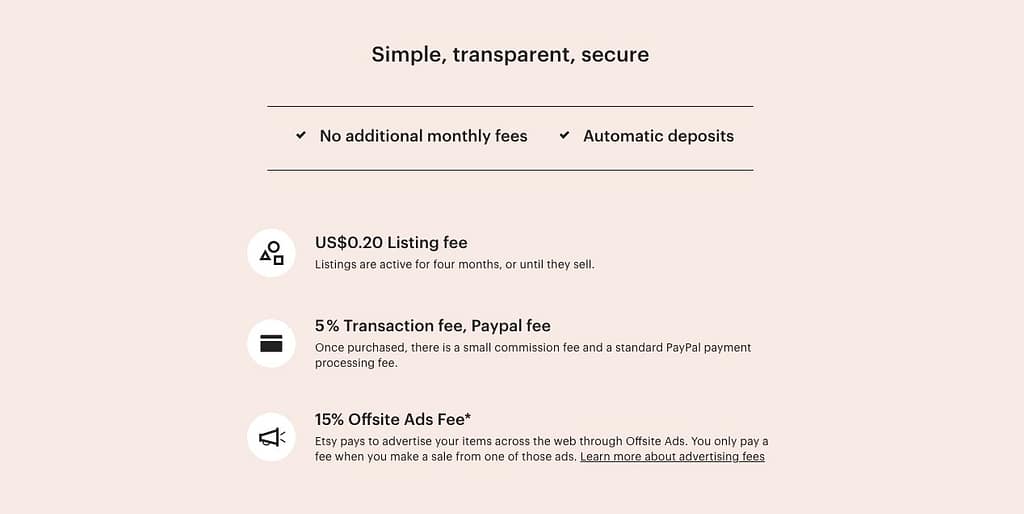
Platforms such as Etsy combine listing fees with transaction commissions, creating multiple revenue streams while keeping entry barriers relatively low for new sellers.
Advertising and Promoted Listings
Advertising and promoted listings allow vendors to pay for additional visibility within the marketplace.
Sponsored products, featured storefronts, homepage placements, and promoted search results help sellers attract more traffic while generating additional revenue for the marketplace operator.
As marketplaces mature and competition between vendors increases, advertising often becomes one of the highest-margin revenue streams available to platform owners.
Money Flow and Split Payments
Once you choose a monetization strategy, you must decide how money will move between buyers, vendors, and the marketplace.
Marketplace payment flows affect compliance, vendor experience, accounting processes, and operational complexity. Modern marketplace software often supports automated split payments, allowing commissions and vendor payouts to be processed automatically.
1. All the money from orders goes to the marketplace owner. The owner then distributes the vendors’ shares at the end of the payment period.
2. The money is distributed automatically among the owner and multiple vendors with every order. This will require setting up a split payment system such as PayPal Commerce Platform or Stripe Connect.
3. All the money from orders goes to vendors and they pay to the marketplace owner at the end of the payment period.
Today, most marketplaces prefer automated split payment systems because they simplify payout management, improve transparency, and reduce administrative overhead. Solutions such as Stripe Connect and PayPal Commerce Platform can automatically distribute funds between vendors and marketplace operators while handling transaction processing and payout automation.
3. Research the eCommerce software market for a reliable platform
Marketplace software is the foundation of your entire business. The platform you choose determines how vendors are managed, how payments are processed, how orders are fulfilled, and how easily the marketplace can scale in the future.
Choosing marketplace software is not simply a technology decision. It affects operational efficiency, launch speed, customer experience, vendor satisfaction, and long-term development costs. Choosing the right marketplace website builder allows founders to balance rapid deployment with the flexibility needed to customize and scale the platform over time.
When evaluating marketplace platforms, focus on three critical areas: marketplace functionality, vendor management capabilities, and scalability.
What to Look for in Marketplace Software
When comparing marketplace platforms, evaluate the following factors:
1. Price/functionality value. You don’t want to spend thousands of dollars on a highly complex marketplace, nor do you need a basic marketplace platform with limited functionality. Research the market, test multi-vendor software, and watch demos to gain an understanding of how to build online marketplace systems tailored to your needs. And then, think whether the price is fair.
2. Quick start and ease of use. Once you’ve finalized the marketplace business model, your next step will be to launch the marketplace MVP. And you won’t be able to do it if the platform requires a significant amount of time to deploy and configure. Therefore, ensure that you can deploy and complete the basic configuration of the marketplace software within one day at the latest.
3. User feedback. User reviews are very helpful. You can learn about the key benefits and disadvantages of the multi-vendor solution, its pitfalls, and practical tips. After collecting comprehensive information, you will be able to determine whether you need to invest in eCommerce image optimization, expand your channels for reaching the target audience, or even completely revamp your business plan strategy. So don’t hesitate to research popular user review platforms such as Capterra, SourceForge, and G2.
4. Technology stack. The technology stack behind a marketplace affects performance, security, integration capabilities, and long-term development flexibility. A reliable stack helps ensure fast page loading, stable operation under normal workloads, secure payment processing, and seamless connections with third-party systems such as CRM, ERP, shipping, and accounting software. It also determines how easily new features can be added and how efficiently developers can maintain and improve the platform over time. Choosing a proven technology stack reduces technical risks and creates a solid foundation for future marketplace development. Understanding how to develop a marketplace website starts with selecting a technology stack capable of supporting marketplace payments, vendor management, integrations, and future scalability.
5. Marketplace app. Mobile commerce continues to grow, making a marketplace app an important consideration for long-term expansion. Native mobile apps can improve customer engagement, increase retention, and create a more convenient buying experience. When evaluating marketplace software, check whether mobile applications are available out of the box or can be launched without significant custom development costs.
We have a detailed guide on creating an app for the marketplace. In this guide, we explain the ins and outs of marketplace app development process, as well as the alternative options. Be sure to read it.
Research the market, test the multi-vendor software, watch demos and video guides to get an idea about the platform’s key features.
Vendor Management Capabilities
The quality of vendor management tools often determines how efficiently a marketplace can grow.
A strong vendor management system should support seller onboarding, approval workflows, commission management, inventory synchronization, vendor dashboards, payout controls, and seller performance tracking.
The more efficiently vendors can manage their business on the platform, the easier it becomes to attract quality sellers and scale marketplace operations.
Platform Scalability
Marketplace scalability should be evaluated from the beginning, even if you are launching a small MVP.
As the platform grows, it must support larger product catalogs, more vendors, increasing transaction volumes, multiple storefronts, additional integrations, and new geographic markets.
Look for marketplace software that offers flexible APIs, customization options, integration capabilities, mobile support, and infrastructure that can handle future growth without requiring a complete platform migration.
4. Pick Between a Ready-Made Platform or Custom Development
Choosing between a ready-made marketplace platform and custom development hinges on your business needs, budget, timeline, and desired level of control and flexibility.
Ready-Made Platforms (SaaS or Open-Source)
Pros:
- Faster launch: Pre-built features and infrastructure let you go live quickly.
- Lower upfront cost: Subscription or licensing fees instead of significant development expenses.
- Managed hosting and updates: The provider handles maintenance, security, and scaling.
- Suitable for standard use cases: Ideal if your marketplace model fits common patterns (e.g., product sales, services).
Cons:
- Limited customization: You’re constrained by the platform’s built-in features and update cycles.
- Scaling costs: Fees often increase with transaction volume, which can potentially limit growth.
- Dependence on vendor: Less control over platform evolution and feature roadmap.
Examples: Mirakl, Marketplacer, Arcadier, Sharetribe, Mercur (open-source but requires technical setup), CS-Cart (open-source with a room for custom development).
Custom Development
Pros:
- Full control and flexibility: Tailor every feature, workflow, and design to your exact needs.
- Scalable and future-proof: Build an architecture that grows with your business without platform-imposed limits.
- Competitive advantage: Unique features can differentiate your marketplace in the market.
Cons:
- Longer time to market: Building from scratch takes more time and resources.
- Higher upfront investment: Requires technical expertise, a development team, and ongoing maintenance.
- Complexity: You assume full responsibility for all technical risks and infrastructure management.
Best suited for enterprise-level businesses or startups with complex, unique marketplace models that require high adaptability (e.g., Mercur, Origami Marketplace, fully custom-builds).
| Approach | Typical Cost |
|---|---|
| No-code marketplace builder | $50–500/month |
| Ready-made marketplace software | $1,000–20,000+ |
| Custom marketplace development | $50,000–500,000+ |
How to choose?
For most startups and first-time marketplace founders, ready-made marketplace software is the fastest and lowest-risk option. It allows you to launch an MVP quickly, validate demand, attract your first vendors and buyers, and avoid the high costs associated with building marketplace infrastructure from scratch.
Custom development becomes a better choice when your marketplace requires highly specialized workflows, unique business logic, enterprise-level integrations, or operational requirements that cannot be supported by existing software.
Many successful marketplaces follow a hybrid path: they start with ready-made marketplace software to validate the business model and achieve product-market fit, then invest in custom development as the platform grows and requires greater flexibility, scalability, and control.
Ready to evaluate marketplace software for your project? Explore a live demo of CS-Cart Multi-Vendor and see how vendor management, split payments, monetization tools, and marketplace automation work in practice.
Step #4. Launch the Marketplace MVP

MVP stands for Minimum Viable Product. It is a simplified version of your marketplace designed to validate demand before significant investments are made in custom development, infrastructure, or advanced functionality.
The primary goal of an MVP is to launch quickly, collect feedback from real users, and determine whether the marketplace creates value for both buyers and sellers.
Marketplace MVP Checklist
Before investing heavily in custom development, most successful marketplace founders launch a Minimum Viable Product (MVP). An MVP is a simplified version of your marketplace designed to validate demand, test user behavior, and identify which features buyers and sellers actually need.
The goal is not to launch a perfect platform but to launch quickly, collect feedback, and improve based on real-world usage. A marketplace MVP helps reduce risk, avoid unnecessary development costs, and achieve product-market fit faster.
A strong marketplace MVP should help you answer four key questions:
- Do buyers find value in the marketplace?
- Are vendors willing to join and sell?
- Does the business model generate revenue?
- Is there enough marketplace liquidity to support future growth?
The faster you can answer these questions, the faster you can make informed decisions about scaling the platform.
Typical Marketplace Launch Timeline
The timeline for launching a marketplace depends on the complexity of the project, the chosen software, and the level of customization. However, most marketplace projects follow a similar path:
| Stage | Typical Timeline |
|---|---|
| Idea validation | 1–4 weeks |
| Market research | 1–2 weeks |
| Business model planning | 1–2 weeks |
| Marketplace software selection | A few days to 2 weeks |
| MVP setup and launch | 1–8 weeks |
| Achieving marketplace liquidity | 3–12 months |
Using ready-made marketplace software can significantly reduce launch time compared to custom marketplace development, allowing founders to validate demand before making larger investments.
What Features Should a Marketplace MVP Include?
A marketplace MVP should focus on the minimum set of features required to facilitate transactions between buyers and sellers. Avoid trying to build every feature at once. Instead, prioritize the functionality necessary to validate your marketplace idea and support real transactions.
Seller Onboarding
Seller onboarding is one of the most important parts of a marketplace MVP. Vendors should be able to register, verify their identity, submit required information, and create their storefronts without unnecessary friction.
The easier it is for sellers to join the platform, the faster you can grow supply and populate your marketplace with products or services.
Read more: Marketplace Seller Onboarding: Step-by-Step Process + Automation Tips
Vendor Dashboard
A vendor dashboard gives sellers control over their business activities within the marketplace. Vendors should be able to manage products, monitor orders, track sales performance, update pricing, and communicate with customers from a single interface.
A well-designed dashboard reduces administrative workload and improves the seller experience.
Inventory Management
Inventory and order management tools allow vendors to maintain accurate product availability and process orders efficiently. Even at the MVP stage, sellers should be able to add products, update inventory levels, and track incoming orders.
For product marketplaces, inventory accuracy directly affects customer satisfaction and marketplace credibility.
Read more: Efficient Inventory Management for E-commerce Success: Tips and Best Practices
Split Payments
Payment processing is one of the core functions of any marketplace. An MVP should support commission management and, ideally, automated split payments that distribute funds between vendors and the marketplace operator.
Automated payment flows simplify financial operations, improve transparency, and reduce manual accounting work as the marketplace grows.
Read more: Split Payments in eCommerce: How Marketplaces Route, Bill & Pay Sellers
Reviews and Ratings
Reviews and ratings help establish trust between buyers and sellers. A transparent feedback system allows customers to share their experiences while helping vendors build credibility over time.
Trust mechanisms become increasingly important as the number of sellers and transactions grows.
Do Marketplace Platforms Have Technical Support, Regular Updates, Installation, and Maintenance Services?
If you’re not a tech-savvy person, it’s best to leave technical aspects to the software provider. Make sure the company assists with platform installation, updates, maintenance, and troubleshooting. Technical support becomes especially important during MVP setup, when issues must be resolved quickly to avoid delays and unnecessary costs.
Many entrepreneurs assume that deploying marketplace software is as simple as signing up for a SaaS application. In reality, self-hosted marketplace platforms often require server configuration, integrations, and ongoing maintenance.
Does the Marketplace Platform Allow You to Scale?
Launching an MVP is only the first stage of building a successful marketplace. If the platform gains traction, you will eventually need to support more vendors, products, customers, transactions, and integrations.
For this reason, scalability should be evaluated before launch rather than after growth begins. Marketplace software should allow you to expand functionality through integrations, add-ons, APIs, and custom development without requiring a complete platform migration.
Make sure the platform can be extended through integrations, add-ons, APIs, or custom development. It should also be capable of handling growing transaction volumes, larger catalogs, and increasing numbers of vendors without requiring a complete rebuild.
What Are Startup Costs?
One of the biggest advantages of launching a marketplace MVP is the ability to test the viability of your marketplace concept without making a large upfront investment.
– No-code marketplace builders typically cost between $50 and $500 per month and are suitable for validating an idea quickly.
– Ready-made marketplace software usually ranges from $1,000 to $20,000+, depending on licensing, hosting, customization requirements, and included functionality.
– Custom marketplace development often starts at $50,000 and can exceed $500,000 for large-scale platforms with unique business logic, integrations, and enterprise-level infrastructure.
Most successful marketplace founders start with an MVP on ready-made software and invest in custom development only after validating demand and achieving marketplace liquidity.
At this stage, your goal is not to build a perfect platform but to test demand, attract your first vendors and buyers, and verify that the business model works.
For most startups, marketplace startup costs can be kept relatively low by using ready-made marketplace software instead of investing immediately in custom development, complex integrations, or expensive infrastructure. Many marketplace platforms also include essential features such as vendor management, payment processing, and mobile apps out of the box, reducing both development time and launch costs.
If you’re evaluating a SaaS marketplace solution, start with the most affordable plan that supports your MVP requirements. There is no need to pay for advanced functionality before you have validated demand and achieved product-market fit.
At this stage, focus on learning rather than building. Collect feedback, analyze user behavior, and invest only in functionality that demonstrates clear value to buyers and sellers. Custom development can be postponed until the marketplace achieves traction and requires greater flexibility or scale.
Not sure whether you need a no-code builder, ready-made marketplace software, or custom development? Our team can help you choose the most cost-effective approach based on your business model and growth plans.
Step #5: Find Sellers and Buyers

One of the biggest challenges when launching a marketplace is attracting both sellers and buyers at the same time. This challenge is often called the “chicken-and-egg problem”: buyers won’t join without enough products or services, while sellers won’t join without customers.

This imbalance between supply and demand is known as the chicken-and-egg problem.
At this stage, the goal is not rapid growth but achieving a balance between supply and demand. You need enough sellers and buyers to prove that transactions can happen consistently within the marketplace.
How to Attract Sellers
Most successful marketplaces focus on acquiring sellers before investing heavily in customer acquisition. This is especially important for niche marketplaces, where a strong catalog or service offering is often the primary reason buyers decide to join. Without inventory, services, or vendors, buyers have little reason to join the platform.
Start by identifying where your target sellers already operate. Depending on your niche, these may include existing marketplaces, social media groups, industry communities, professional associations, trade shows, local business directories, or specialized forums.
Early sellers often join for one of three reasons:
- access to a new customer base;
- lower fees than competing platforms;
- better tools, visibility, or monetization opportunities.
At the early stage, founder-led outreach is often the most effective acquisition channel. Contact potential vendors directly, explain the marketplace’s value proposition, and gather feedback about what would motivate them to join.
Seller onboarding should be as simple as possible. The less effort required to create an account, upload products, and start selling, the easier it becomes to grow marketplace supply.
For more information on attracting vendors to your multi-vendor marketplace platform, please visit our Marketplace Academy.
How to Attract Customers
Customer acquisition becomes significantly easier once a marketplace has enough supply to create value for buyers. Without sufficient supply, even the best marketing campaigns will struggle to generate repeat visits or transactions.
Before launch, start building an audience through landing pages, waitlists, newsletters, social media content, and community-building activities. Collect email addresses of potential customers and keep them informed about the marketplace launch.
To attract your first buyers, focus on the places where your target audience already spends time:
- niche communities and online forums;
- social media groups;
- industry newsletters;
- YouTube channels and influencers;
- offline events and professional meetups.
Content marketing, SEO, referral programs, partnerships, and targeted paid advertising can all help generate initial traffic. However, early-stage marketplaces often achieve the best results by building communities around a specific problem, industry, or interest rather than relying exclusively on advertising.
Customer acquisition is one of the biggest challenges for new marketplaces. The most successful platforms continuously balance seller growth and buyer acquisition, improving marketplace liquidity and creating stronger network effects over time.
Step #6: Launch Your Marketplace

If you’re planning how to launch an eCommerce marketplace, focus on collecting feedback from early adopters, improving marketplace liquidity, and creating awareness before scaling acquisition efforts. At this point, you have validated your idea, launched an MVP, attracted your first sellers and buyers, and are ready to introduce the marketplace to a broader audience.
After launch, your focus shifts from building the platform to improving the user experience, increasing marketplace liquidity, attracting new users, and establishing market visibility.
Polish the Marketplace Based on User Feedback
The first version of your marketplace will never be perfect. This is why early adopters are so valuable. They help identify usability issues, missing features, onboarding friction, and operational bottlenecks that may not have been obvious during development.
Actively collect feedback from both buyers and sellers through surveys, interviews, support requests, reviews, and behavioral analytics. Pay close attention to where users abandon the onboarding process, struggle to complete transactions, or encounter friction.
Focus on solving the most impactful problems first. Small improvements to onboarding, search, checkout, vendor management, or payment flows often generate a greater return than adding entirely new features.
The goal during this stage is continuous optimization based on real marketplace activity rather than assumptions.
Get Press Coverage and Early Visibility
Once the marketplace is live, start building awareness beyond your existing network. Early visibility helps attract new buyers, recruit additional sellers, and establish credibility within your niche.
Press coverage can be an effective way to generate attention, especially for niche marketplaces with a unique value proposition or compelling founder story. Industry publications, niche blogs, podcasts, newsletters, and online communities often provide better results than trying to target large mainstream media outlets immediately.
In addition to PR, leverage your existing network of vendors, customers, partners, and early adopters. Encourage them to share the marketplace, provide testimonials, and create social proof around the platform.
Step #7: Promote Your Online Marketplace

Once your marketplace is live and marketplace liquidity begins to improve, growth becomes the primary objective. At this stage, marketing is no longer about generating awareness alone—it is about attracting qualified buyers, increasing transaction volume, and strengthening network effects between buyers and sellers.
The most successful marketplaces continuously invest in customer research, seller enablement, and competitive analysis to identify new growth opportunities.
Read more: Marketplace Marketing Strategy: A Practical Guide to Growth and Liquidity
Understand Your Customers to Create Effective Marketing Campaigns
Effective marketplace marketing starts with understanding your customers. The better you understand buyer motivations, purchasing behavior, pain points, and decision-making processes, the easier it becomes to create campaigns that generate engagement and conversions.
Use analytics, surveys, customer interviews, support requests, and behavioral data to identify patterns in how users discover products, evaluate sellers, and complete transactions. This information can help you improve both marketing performance and the marketplace experience itself.
Personalized offers, targeted promotions, lifecycle email campaigns, and audience segmentation often outperform generic advertising because they are based on actual customer behavior rather than assumptions.
The goal is not simply to generate traffic but to attract buyers who are most likely to become repeat customers and contribute to long-term marketplace growth.
Use Your Sellers’ Resources to Promote the Platform
Marketplace growth should not rely entirely on the platform owner. Sellers can become one of the most effective acquisition channels when they are encouraged to actively promote their products and storefronts.
Provide vendors with marketing guidelines, promotional materials, SEO recommendations, email marketing templates, and best practices for customer acquisition. The more successful sellers become, the more value they bring to the marketplace.
Referral programs, co-marketing initiatives, affiliate partnerships, and vendor-led content can significantly expand marketplace reach while reducing customer acquisition costs.
When sellers promote their own businesses, they also promote the marketplace itself, creating a mutually beneficial growth cycle.
Learn From Competitors and Improve Their Ideas
Competitor research is one of the fastest ways to identify proven growth opportunities. Study how successful marketplaces attract users, improve conversions, onboard sellers, and monetize their platforms.
Pay attention to loyalty programs, referral systems, subscription offerings, marketplace categories, promotional campaigns, and user experience improvements. The objective is not to copy competitors but to understand what works and adapt those ideas to your own marketplace and audience.
Many successful marketplace features—including wishlists, product recommendations, loyalty programs, seller ratings, and subscription memberships—have spread across the industry because they consistently improve user engagement and retention.
Continuous testing and iteration will help you discover which ideas create the greatest value for your buyers and sellers.
For more information on promoting your multi-vendor marketplace, visit our Marketplace Academy.
Growing and Scaling Your Marketplace
Launching a marketplace is only the beginning. Once transactions start flowing and marketplace liquidity improves, the focus shifts toward sustainable growth, operational efficiency, and long-term scalability.
Successful marketplaces continuously optimize their technology, strengthen network effects, improve user experience, and adapt to changing market conditions.
What Makes a Successful Marketplace Business?
While every marketplace is different, the most successful marketplace businesses share several common characteristics:
- Marketplace liquidity that allows buyers to consistently find relevant products or services and helps sellers generate transactions.
- Strong seller acquisition and onboarding processes that continuously expand marketplace supply.
- Scalable marketplace software capable of supporting growing numbers of vendors, products, orders, and customers.
- Automated payments and payout systems that reduce operational overhead and improve the seller experience.
- A clear monetization strategy based on commissions, subscriptions, listing fees, advertising, or a combination of revenue streams.
- Network effects that increase marketplace value as more buyers and sellers join the platform.
Together, these elements create a foundation for sustainable marketplace growth and long-term competitiveness.
Platform Scalability
As your marketplace grows, the platform must support increasing numbers of vendors, products, orders, and customers without compromising performance.
Scalability extends beyond technical infrastructure. It also includes operational processes, vendor management, payment systems, customer support, and marketplace governance. A scalable marketplace should be able to expand into new categories, support larger transaction volumes, integrate additional services, and enter new geographic markets without requiring a complete rebuild.
This is why choosing scalable marketplace software early in the development process can significantly reduce future migration costs and operational complexity.
Common Marketplace Challenges

Even successful marketplaces face ongoing challenges as they grow. Some of the most common obstacles include:
- maintaining marketplace liquidity as supply and demand evolve;
- attracting new vendors and buyers without overspending on acquisition;
- building trust through reviews, ratings, and secure transactions;
- responding to increasing competition and changing customer expectations;
- complying with evolving regulations related to payments, privacy, and consumer protection;
- managing cross-border operations and localization requirements;
- marketplace governance and seller quality control;
- maintaining customer satisfaction while scaling operations.
Many marketplace founders also make avoidable mistakes during the growth stage, such as building new features before validating demand, prioritizing technology over marketplace liquidity, launching without enough sellers, or delaying marketing efforts until after launch.
Ultimately, how to build a successful marketplace business comes down to achieving marketplace liquidity, creating sustainable network effects, and continuously improving the experience for both buyers and sellers.
Marketplace Trends in 2026
To remain competitive in 2026, marketplace operators should pay close attention to several major industry trends.
AI-Powered Marketplace Operations. Artificial intelligence is increasingly used to automate seller onboarding, product moderation, fraud detection, customer support, catalog enrichment, and operational workflows.
Social Commerce and Creator-Led Marketplaces. Social platforms continue to influence purchasing decisions, while creator communities and influencer-driven marketplaces are becoming powerful acquisition channels.
B2B Marketplace Growth. Manufacturers, distributors, and wholesalers are increasingly adopting marketplace models to streamline procurement and expand their digital sales channels.
Marketplace Automation. Automated payments, vendor management, order routing, customer support, and catalog management help marketplaces scale more efficiently while reducing operational costs.
Sustainability and Ethical Commerce. Buyers are paying greater attention to sustainable products, transparent supply chains, and responsible business practices, creating new opportunities for marketplaces that prioritize trust and transparency.
Marketplace trends will continue to evolve, but the marketplaces that adapt quickly to changing buyer expectations and technology innovations will be best positioned for long-term growth.
Read more: 7 Marketplace Trends You Can’t Ignore When Starting a Marketplace in 2025
| Feature | Why It Matters |
|---|---|
| Vendor Management | Allows you to onboard sellers, manage approvals, monitor performance, and control marketplace operations. |
| Split Payments | Automates commission collection and vendor payouts, reducing manual financial work. |
| Scalability | Supports growing numbers of vendors, products, orders, and customers without requiring platform migration. |
| APIs and Integrations | Connects the marketplace with CRM, ERP, shipping, payment, and marketing systems. |
| Mobile Apps | Improves buyer and seller engagement and supports mobile commerce growth. |
| Analytics and Reporting | Helps monitor marketplace performance, track KPIs, and make data-driven decisions. |
When evaluating marketplace software, prioritize the features that directly support your business model, vendor ecosystem, and long-term growth plans. Choosing software that lacks critical marketplace functionality often leads to costly migrations and custom development later.
Building a successful marketplace requires more than software alone. The right platform, payment infrastructure, vendor management tools, and growth strategy all play a critical role.
Successful Marketplace Examples
Let’s explore some successful marketplace examples, including notable global cases that showcase originality in diverse niches.
Yumbles (UK)

A beautifully curated food marketplace on CS-Cart, connecting independent UK food artisans directly with consumers. It focuses on handmade, locally sourced food products, emphasizing quality and artisanal craftsmanship rather than mass-market goods.
Mode (New Zealand)

Another example of a CS-Cart powered marketplace. A niche fashion marketplace exclusively featuring New Zealand-based boutiques and designers. This hyperlocal focus supports local businesses and appeals to consumers seeking unique, locally sourced fashion items.
PreciousPlastic

A peer-to-peer marketplace on CS-Cart and an open-source platform, enabling individuals worldwide to share plastic recycling tools and knowledge. It’s a unique blend of marketplace, community, and sustainability initiative, empowering local circular economies rather than just commercial transactions.
DentaCarts (Egypt)

A specialized business-to-business marketplace for dental products, aiming to provide dentists with access to original and innovative products, addressing the problem of counterfeit goods in the market. DentaCarts has built a growing network of dental suppliers and buyers across the region, highlighting CS-Cart’s suitability for B2B and regulated industries.
Urbankissed

Urbankissed is an online boutique marketplace specializing in handmade treasures and unique finds from carefully curated small brands that prioritize artisan care and sustainability. Founded in 2017 by Swiss entrepreneur Sophie during her fashion business studies, the platform offers a thoughtfully selected range of products including handcrafted knitwear, eco-friendly accessories, hemp bags, and artisanal candles. Urbankissed emphasizes ethical slow fashion and supports brands with innovative, eco-conscious production methods, such as fabrics made from banana or milk fibers and zero-waste processes. The marketplace also plants a tree for every delivery, contributing to environmental sustainability. With a focus on quality, authenticity, and a premium customer experience, Urbankissed connects conscious consumers worldwide directly to small producers, bypassing traditional warehousing and fostering a positive social and ecological impact.
CS-Cart’s flexibility supports diverse business models, from mass-market giants like Amazon and eBay to industry-specific niche platforms, making it a versatile choice for marketplace entrepreneurs.
Why Entrepreneurs Choose CS-Cart for Marketplace Development
Choosing the right marketplace software can significantly affect how quickly you launch, how easily you scale, and how much flexibility you have as your business grows.
CS-Cart Multi-Vendor is designed specifically for online marketplaces and includes the core functionality required to launch and manage a multi-vendor platform without building everything from scratch. Marketplace owners can manage vendors, commissions, payouts, orders, products, and customer interactions from a centralized administration panel.
The platform includes features that marketplace founders typically need during every stage of growth:
- seller onboarding and vendor management tools;
- vendor dashboards and inventory management;
- commission management and split payment integrations;
- product catalog and order management;
- multiple monetization options;
- mobile applications for buyers and sellers;
- API and customization capabilities;
- marketplace automation and third-party integrations.
Unlike many SaaS marketplace builders, CS-Cart provides access to the source code, allowing businesses to customize workflows, integrations, and user experiences as requirements evolve. At the same time, startups can launch quickly using built-in functionality and expand gradually through add-ons, integrations, and custom development.
If you’re ready to start building your marketplace, explore the CS-Cart Multi-Vendor demo and evaluate how its features align with your business model and growth plans.
Frequently Asked Questions
What are the key steps to build an online marketplace from scratch?
Building a marketplace typically involves seven key stages: validating a marketplace idea, researching the market, choosing a business model, selecting marketplace software, launching an MVP, attracting sellers and buyers, and scaling the platform based on user feedback and market demand. The most successful marketplaces focus on validating demand before investing heavily in custom development.
What is a multi-vendor marketplace platform?
A multi-vendor marketplace platform is software that allows multiple independent sellers to offer products or services through a single website or app. The marketplace owner manages the platform, while vendors manage their own products, inventory, pricing, and orders. Popular examples include marketplaces similar to Amazon, Etsy, and eBay.
How important is market research when launching an online marketplace?
Market research is one of the most important steps in marketplace development. It helps validate demand, identify customer pain points, analyze competitors, estimate market size, and uncover opportunities for differentiation. Skipping this stage often leads to building a marketplace that solves a problem nobody is actively trying to solve.
How do marketplace split payments work?
Split payments automatically distribute funds from a transaction between the marketplace operator and participating vendors. Instead of manually processing payouts, marketplace software can calculate commissions and route payments using solutions such as Stripe Connect or PayPal Commerce Platform. This simplifies financial management and improves transparency for sellers.
How much does it cost to build an online marketplace in 2026?
Marketplace development costs vary significantly depending on the approach. No-code marketplace builders may start at tens of dollars per month, ready-made marketplace software typically ranges from several hundred to several thousand dollars, while custom marketplace development can cost tens or even hundreds of thousands of dollars. Many founders reduce risk by launching an MVP before investing in advanced customizations.
What is the best marketplace software for startups?
The best marketplace software for startups is typically a solution that allows founders to launch quickly, validate demand, and scale without requiring extensive custom development. Look for software that includes vendor management, payment integrations, split payments, mobile support, and customization options. The ideal choice depends on your business model, budget, and growth plans.
How long does it take to launch a marketplace MVP?
With modern marketplace software, an MVP can often be launched within days or weeks rather than months. The timeline depends on platform selection, customization requirements, content preparation, payment setup, and vendor onboarding. Most founders should prioritize speed and validation over building a fully featured platform at launch.
What steps should be taken to plan for marketplace scalability?
Marketplace scalability should be considered from the beginning. Choose software that can support increasing numbers of vendors, products, orders, and integrations. Flexible APIs, automation tools, customizable workflows, and scalable infrastructure help marketplaces grow without requiring costly migrations or complete platform rebuilds.
How can legal compliance be ensured when creating a marketplace?
Marketplace operators should review regulations related to consumer protection, privacy, payment processing, taxation, and vendor agreements. Requirements vary by country and industry, so consulting legal professionals during the planning stage can help reduce compliance risks and avoid costly issues later. Legal requirements for running a marketplace typically include business registration, tax compliance, privacy regulations (such as GDPR), payment processing requirements, consumer protection rules, seller agreements, dispute resolution policies, and marketplace-specific regulations depending on the industry and geography.
What factors should be considered when choosing marketplace software?
Key factors include marketplace functionality, vendor management capabilities, payment options, split payment support, scalability, customization flexibility, mobile readiness, integration options, technical support, and total cost of ownership. The right software should support both your current MVP requirements and long-term growth plans.
How do you build a marketplace website without coding?
Many entrepreneurs launch marketplaces using no-code or low-code marketplace platforms that include vendor management, product catalogs, payment processing, mobile applications, and administrative tools out of the box. These solutions allow founders to validate their business ideas and launch faster without hiring a development team.
Can I build a marketplace without custom development?
Yes. Many successful marketplaces start with ready-made marketplace software and use built-in functionality to validate their business model. Custom development is often introduced later when the marketplace requires specialized workflows, unique features, or enterprise-level integrations.
What is marketplace liquidity?
Marketplace liquidity is the ability of buyers to consistently find relevant products or services and complete transactions while sellers successfully generate sales. Liquidity is one of the most important indicators of marketplace success because it reflects the balance between supply and demand.

eCommerce expert with 10+ years of experience in marketplace management and consumer behavior. Gayane tracks the latest industry trends to provide businesses with analytical, actionable insights.