
Your online store is growing. Vendors want to sell through your platform. Customers are asking for more products than you can source yourself. Suddenly, launching a marketplace feels like the natural next step.
The challenge is choosing a platform that won’t become a limitation a year later. Many small businesses start with marketplace software designed for quick launches, only to discover that adding vendors, integrating ERP systems, supporting B2B buyers, or expanding into multiple storefronts requires expensive workarounds—or a complete migration.
Businesses that successfully transition from a single online store to a marketplace can unlock new revenue streams, expand product catalogs without holding inventory, and create stronger network effects between buyers and sellers.
In this guide, we’ll compare the best marketplace platforms for small businesses and startups in 2026, focusing on what matters most: scalability, vendor management, customization, integrations, and long-term growth.
– Most small businesses should prioritize vendor management, payment automation, integrations, and scalability over short-term cost savings. Replatforming later is often more expensive than choosing the right marketplace software from the start.
– Multi-Vendor by CS-Cart stands out as one of the few marketplace platforms that supports both rapid launch and long-term growth. Businesses can start with built-in marketplace functionality and later expand into B2B, multi-storefront, and advanced custom workflows without changing platforms.
Why Small Businesses Need Specialized Marketplace Platforms
Many small businesses don’t start as marketplaces. Instead, they often begin by selling through established online marketplaces before deciding to build a marketplace of their own. Most start as online stores, distributors, wholesalers, or niche brands selling their own products. As the business grows, new opportunities emerge: suppliers want to join the platform, customers ask for a wider product selection, and expansion into new markets becomes a realistic goal.
At that point, a traditional eCommerce platform often becomes limiting. Managing multiple vendors, automating payouts, controlling product quality, and handling marketplace operations requires functionality that standard online store software wasn’t designed to provide. This is why many growing businesses eventually move to a multi-vendor marketplace model, where multiple independent sellers can manage products, orders, and customer interactions through a single platform.
A specialized marketplace platform helps businesses move beyond a single-store model without building everything from scratch. This is one of the clearest examples of how online marketplaces help small startups expand product selection, attract new sellers, and generate additional revenue without investing in inventory.
Read more: How to Start an Online Marketplace in 2026: 7 Steps to Build a Successful Marketplace Business
Challenges Small Businesses Face When Launching a Marketplace
Launching a marketplace introduces a completely different level of complexity compared to running a traditional online store.
One of the biggest challenges is vendor management. Instead of managing products from a single supplier, marketplace owners must onboard vendors, review products, monitor performance, and handle disputes.
Operational processes become more complicated as well. Orders may contain products from multiple vendors, requiring split payments, separate shipping workflows, and more advanced reporting.
Many founders also worry about scalability. A platform that works well with 10 vendors may struggle when the marketplace expands to 100 or 1,000 sellers. Replatforming later can be expensive and disruptive.
Integration requirements add another layer of complexity. Businesses often need connections to CRM, ERP, accounting, inventory, shipping, and marketing systems while maintaining a smooth experience for both buyers and vendors.
What Makes a Marketplace Platform Suitable for Small Businesses
The best marketplace platforms for small businesses balance simplicity with scalability.
A good solution should allow founders to launch quickly without requiring a large development team. At the same time, it should provide enough flexibility to support long-term expansion, new business models, and custom workflows.
Marketplace owners should look for platforms that offer:
- Built-in vendor management
- Automated commission and payout systems
- Flexible customization options
- Integration capabilities
- Strong reporting and analytics
- Reliable customer support
- Multi-storefront and B2B support
- A clear growth path without requiring a complete migration
Additional requirements may vary depending on the marketplace business model. For example, marketplaces selling software, digital downloads, online courses, or subscription-based products should also evaluate subscription support, digital delivery tools, and access management features.
The goal isn’t simply to launch a marketplace. It’s to build a platform that can support the business for years as operations become more sophisticated.
Essential Features of Marketplace Platforms for Small Businesses
Not every marketplace platform offers the same level of functionality. Some solutions focus on simplicity and rapid deployment, while others prioritize flexibility and long-term scalability.
Before choosing a platform, evaluate the features that will have the greatest impact on daily operations and future growth. The key features discussed below can help determine whether a platform is suitable for your current needs and future growth plans.
Easy Storefront Setup and Customization
Small businesses rarely have the budget for lengthy development projects. A marketplace platform should provide ready-made storefront functionality while still allowing customization of branding, design, user experience, and workflows.
The best solutions let businesses launch quickly without sacrificing the ability to adapt the platform as requirements evolve.
Vendor Management Tools
Vendor management is the foundation of every marketplace.
Marketplace owners need tools for vendor onboarding, approval workflows, commission management, performance monitoring, communication, and product moderation.
Without these capabilities, managing sellers becomes increasingly difficult as the marketplace grows.
Payment Gateways and Split Payment Support
Marketplace payments are significantly more complex than standard online store transactions. Choosing the right payment gateway is critical because it affects the checkout experience, transaction security, payout automation, and support for marketplace-specific payment flows.
Customers may purchase products from multiple vendors in a single order, requiring automated commission calculations and payout distribution. Efficient payment processing helps automate transactions, reduce manual work, and improve the checkout experience for both buyers and sellers.
Look for platforms that support marketplace payment solutions such as Stripe Connect and other split-payment providers, reducing manual financial operations.
Inventory Management and Order Processing
As product SKUs grow, inventory management becomes critical.
Marketplace software should provide centralized order management, inventory tracking, shipping integrations, and automated notifications for buyers and vendors.
Efficient order processing helps reduce operational costs while improving the customer experience.
Customer Data and Analytics
Growth decisions should be based on data rather than assumptions.
Marketplace owners need visibility into sales performance, vendor activity, customer behavior, conversion rates, top-performing products, and revenue sources.
AI Tools and Automation Features
Artificial Intelligence is becoming increasingly valuable for marketplace operations.
Modern platforms can help automate product content generation, catalog management, customer support, product recommendations, fraud detection, and marketing activities. These capabilities can be especially valuable for digital marketplaces where product catalogs change frequently and content must be updated at scale.
For small teams, automation reduces manual workload and allows employees to focus on growth initiatives instead of repetitive administrative tasks.
Scalability for Future Growth
Perhaps the most important feature is scalability.
The right platform should support business growth without forcing a costly migration every few years. Whether the marketplace expands to multiple countries, launches B2B functionality, adds multiple storefronts, or grows from dozens to thousands of vendors, the platform should remain capable of supporting those changes. This flexibility is particularly valuable for software marketplaces for startup tech products, where product catalogs, subscriptions, and integrations often become more complex over time.
As the business grows, advanced features such as B2B tools, automation, multi-storefront management, and custom workflows become increasingly important.
Best Marketplace Platforms for Small Businesses
We evaluated marketplace platforms based on criteria that matter most to small businesses and startup founders:
- Marketplace functionality out of the box (vendor management, commissions, payouts, onboarding)
- Ease of launch without requiring a large development team
- Total cost of ownership, including software, hosting, apps, and maintenance
- Scalability from MVP stage to a growing marketplace
- Customization flexibility for unique business models
- Market adoption and ecosystem maturity
- Support for different marketplace types (B2C, B2B, services, rentals, classifieds)
Feature requirements also vary by marketplace type. For example, service marketplaces often require booking workflows, provider management, and scheduling capabilities.
These marketplace models represent some of the most common types of marketplaces for small business owners entering the platform economy.
We focused on solutions that are actively used by small businesses and marketplace startups in 2026, rather than general eCommerce platforms that require significant customization to support multiple vendors.
Multi-Vendor by CS-Cart
Why small businesses choose it
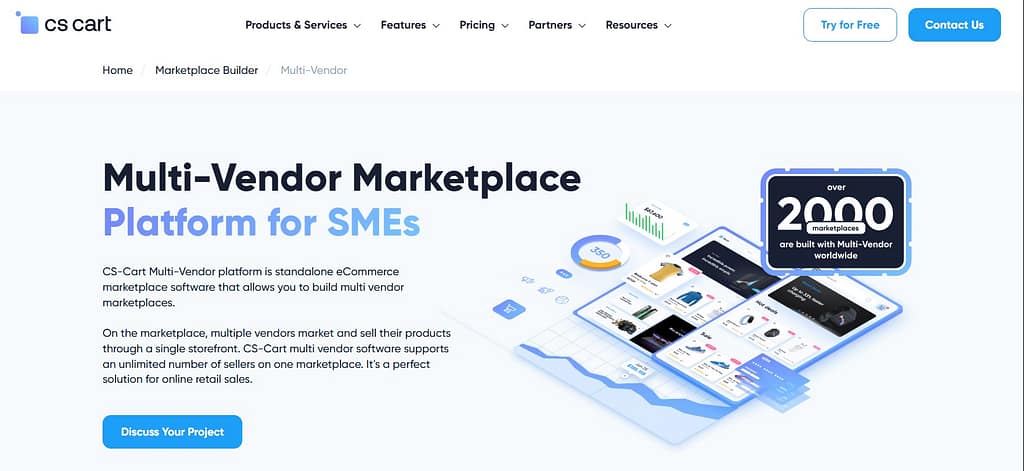
Multi-Vendor by CS-Cart combines the simplicity of a SaaS platform with marketplace-specific functionality that is ready to use from day one. Unlike SaaS solutions, it offers open code access, allowing owners to customize workflows, integrations, vendor experiences, and business logic without platform limitations.
Small businesses can launch with built-in vendor management, commission systems, seller dashboards, payments, and marketplace automation, then gradually expand into B2B commerce, multi-storefront operations, advanced integrations, and custom functionality as requirements evolve. This flexibility makes CS-Cart Multi-Vendor a strong choice for businesses that want to start small while maintaining the freedom to scale without replatforming later.
Pros
- Marketplace functionality included out of the box
- Easy setup with fast launch time
- Vendor management and commission tools included
- Mobile apps available for buyers and vendors
- Scalability path to a fully customizable solution
Cons
- Fewer third-party apps than Shopify
Sharetribe

Why small businesses choose it
Sharetribe is popular among startups because it allows founders to validate marketplace ideas without building a platform entirely from scratch. It is often chosen by entrepreneurs seeking a relatively fast path from idea validation to marketplace launch. The platform provides marketplace fundamentals while giving developers API access for custom functionality. Many businesses use it to test niche marketplace concepts before investing in a larger platform. However, growing customization needs often increase development costs over time.
Pros
- Fast MVP development
- API-first architecture
- Strong marketplace focus
- Flexible business models
- Good documentation
Cons
- Developer involvement is often required
- Customization costs can grow quickly
- Limited built-in functionality compared to mature platforms
- Scaling complex workflows may require significant development
You may also be interested in reading: Sharetribe vs. CS-Cart: Which Marketplace Platform Best Suits Your Business Needs?
Shopify Marketplace Apps
Why small businesses choose it
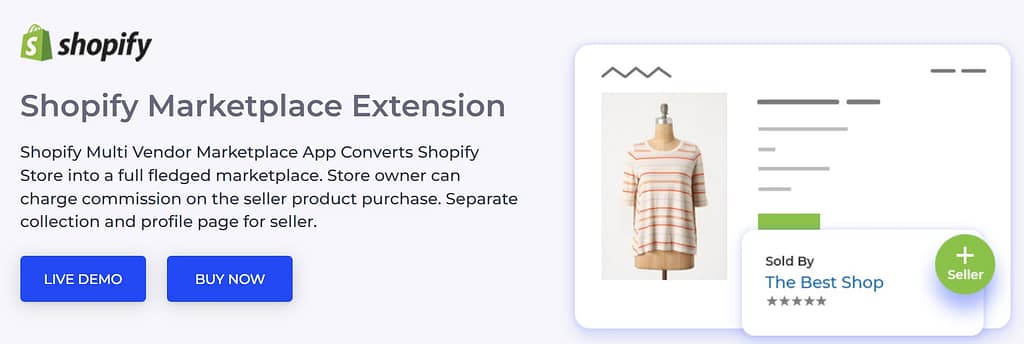
Businesses already running Shopify stores often prefer marketplace apps because they can build on existing infrastructure. Apps such as Webkul Multi Vendor Marketplace make it possible to add vendors without migrating to a new platform. This can reduce implementation time and simplify operations. However, marketplace functionality depends heavily on third-party apps rather than being built into the platform itself.
Pros
- Familiar Shopify ecosystem
- Large app marketplace
- Fast setup for existing Shopify users
- Strong design and theme options
Cons
- Marketplace functionality relies on third-party apps
- Monthly costs can increase significantly
- Limited control over platform architecture
- Custom workflows may be difficult to implement
Get more insights from our article: Shopify vs CS-Cart Multi-Vendor: Which Platform Best Suits Your Marketplace Goals?
Dokan
Why small businesses choose it
Dokan extends WooCommerce with multi-vendor functionality and offers an affordable way to build a marketplace. Businesses familiar with WordPress can leverage existing knowledge and plugins. It provides a good balance between flexibility and cost for smaller marketplaces. However, ongoing maintenance and plugin compatibility can become challenging as the platform grows.
Pros
- Affordable entry cost
- Built on WooCommerce
- Large WordPress ecosystem
- Flexible plugin options
Cons
- Requires ongoing maintenance
- Plugin conflicts can occur
- Performance may become an issue at scale
- Security depends on site management
Read more: CS-Cart or Dokan Multi-Vendor? Which Solution Is Best for Your Marketplace Business
Arcadier
Why small businesses choose it
Arcadier focuses on ease of use and rapid deployment. Businesses can launch niche marketplaces without managing hosting or development infrastructure. This makes the platform attractive for founders with limited technical skills who want to launch quickly. The platform supports several marketplace models and offers a straightforward onboarding experience. Its simplicity appeals to founders, though larger businesses may eventually outgrow its capabilities.
Pros
- Fast launch process
- Minimal technical requirements
- Multiple marketplace models supported
- Cloud hosting included
Cons
- Limited customization options
- Fewer advanced features
- Less flexibility than open-code platforms
- Scaling options are more limited
Yo!Kart
Why small businesses choose it
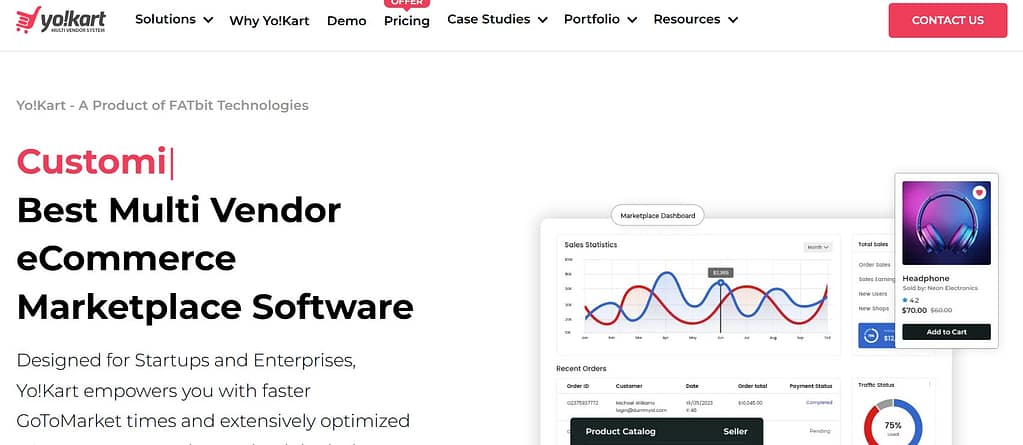
Yo!Kart appeals to businesses that want ownership of their platform and prefer avoiding recurring SaaS fees. It includes many marketplace features out of the box and supports B2B and B2C business models. The platform is often considered by founders comparing alternatives to SaaS solutions. Additional flexibility is available but usually requires developer support.
Pros
- One-time license option
- Self-hosted deployment
- Core marketplace features included out of the box
- Supports B2B and B2C models
Cons
- Smaller ecosystem than major competitors
- Custom development often required
- Fewer integrations available
- UI feels dated compared to newer platforms
ShipTurtle
Why small businesses choose it
ShipTurtle adds multi-vendor functionality to Shopify stores without requiring a platform migration. Businesses can onboard vendors and manage commissions while remaining inside the Shopify ecosystem. The solution is attractive for companies already committed to Shopify. However, long-term scalability depends on Shopify’s architecture and app ecosystem.
Pros
- Easy Shopify integration
- Quick implementation
- Supports vendor commissions
- Lower entry barrier
Cons
- Dependent on Shopify
- Limited customization options
- Marketplace capabilities are less comprehensive
- Growing complexity may require additional apps
Kreezalid
Why small businesses choose it
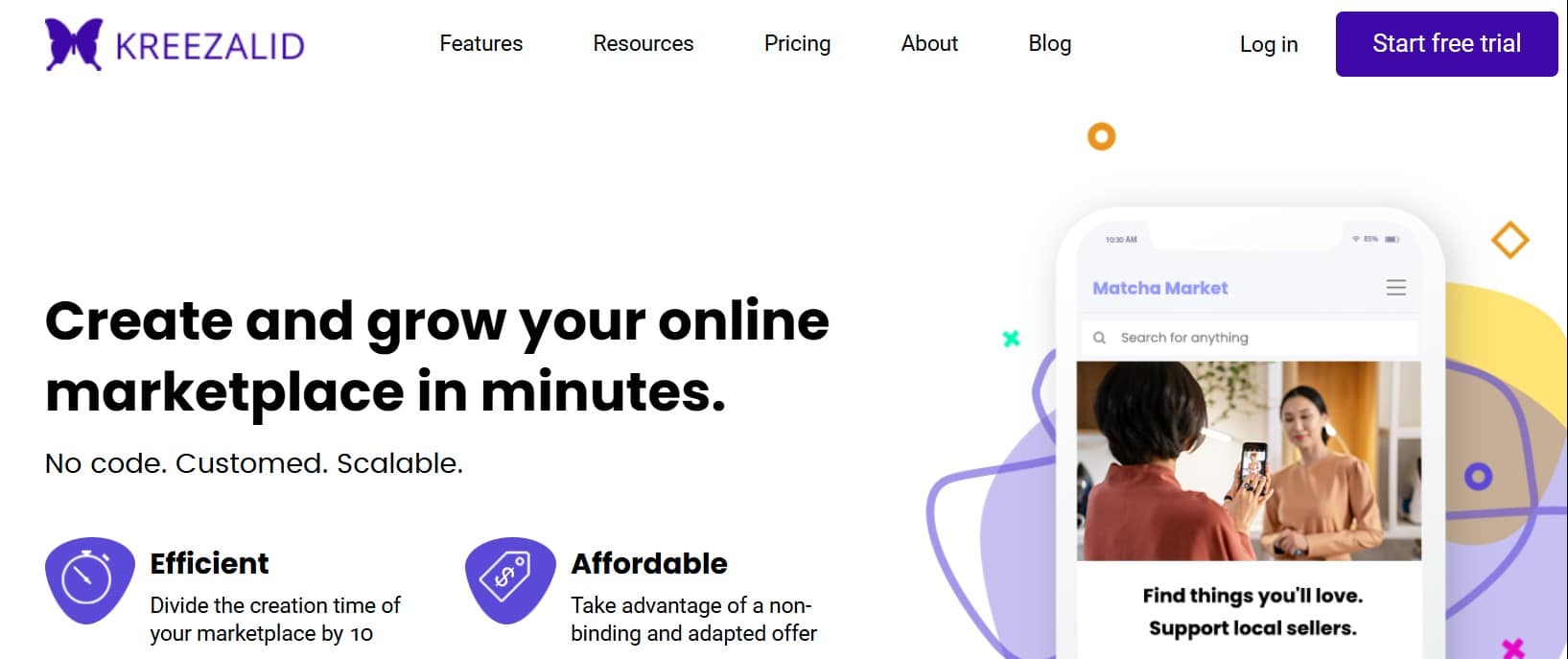
Kreezalid provides a user-friendly environment for launching marketplaces without coding. It supports product, service, and rental marketplace models while offering built-in marketplace management tools. Small businesses appreciate the ease of setup and lower technical requirements. However, customization and enterprise-level scalability are more limited.
Pros
- No-code marketplace builder
- Supports multiple business models
- Simple administration tools
- Quick deployment
Cons
- Limited customization
- Smaller ecosystem
- Fewer advanced integrations
- Less suitable for complex marketplace operations
Yclas

Why small businesses choose it
Yclas focuses on classified advertising and local marketplace use cases. Businesses can launch listing-based platforms quickly while benefiting from built-in monetization tools. It is particularly suitable for local service directories and classifieds websites. However, it lacks many advanced features required by larger transactional marketplaces.
Pros
- Simple setup
- Suitable for classifieds
- Built-in monetization tools
- Affordable pricing
Cons
- Not designed for complex marketplaces
- Limited vendor management
- Fewer integrations
- Less scalable than dedicated marketplace platforms
Comparison Table of Marketplace Platforms
Before comparing individual solutions, it’s worth noting that there is no single best marketplace platform for every business. The right choice depends on whether your priority is rapid launch, marketplace validation, long-term scalability, or complete ownership of your platform.
| Platform | Best For | Deployment | Vendor Management | Customization | Scalability |
|---|---|---|---|---|---|
| Multi-Vendor by CS-Cart | Growing marketplace businesses | Self-Hosted | Excellent | Medium | High |
| Sharetribe | MVPs and startups | SaaS/API | Good | High | Medium |
| Shopify Marketplace Apps | Shopify merchants | SaaS | Good | Medium | Medium |
| Dokan | WordPress users | Self-hosted | Good | High | Medium |
| Arcadier | Fast marketplace launches | SaaS | Good | Low | Medium |
| Yo!Kart | Self-hosted marketplaces | Self-hosted | Good | High | High |
| ShipTurtle | Shopify extensions | SaaS/App | Basic | Medium | Medium |
| Kreezalid | No-code marketplaces | SaaS | Good | Low | Medium |
| Yclas | Classified marketplaces | SaaS/Self-hosted | Basic | Low | Low |
How to Choose the Right Marketplace Platform for Your Business
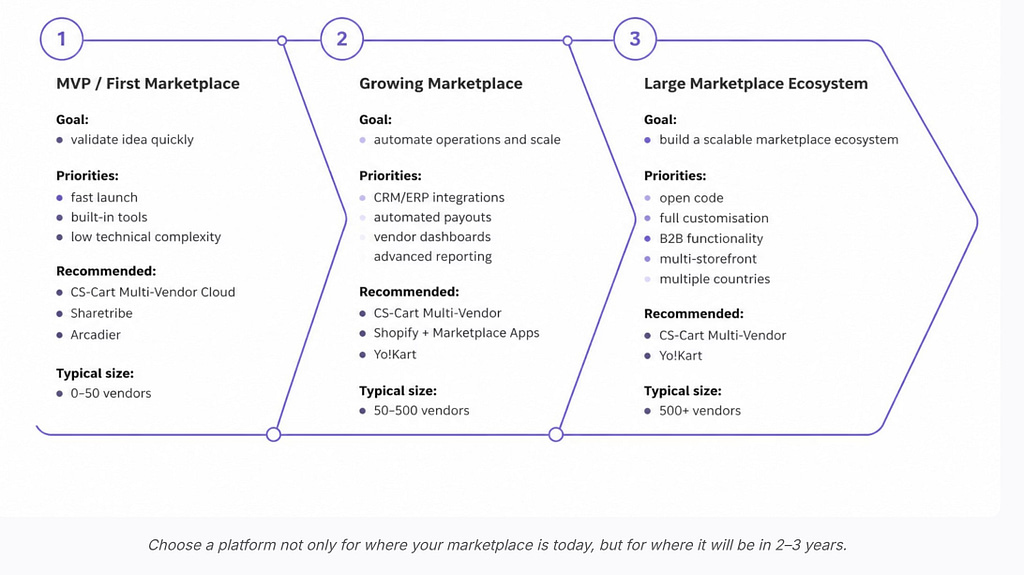
The best marketplace platform isn’t necessarily the one with the most features. It’s the one that matches your current business stage while giving you room to grow. Before making a decision, think about where your marketplace will be in one year—not just where it is today.
For First-Time Marketplace Founders
If you’re launching your first marketplace, prioritize speed, simplicity, and built-in functionality. You don’t need enterprise-level customization on day one. Instead, look for a platform that includes vendor onboarding, commission management, payment processing, and marketplace administration tools out of the box.
Solutions like Multi-Vendor Cloud by CS-Cart, Sharetribe, and Arcadier can help validate your business idea quickly while minimizing upfront technical complexity. These platforms also support common marketplace strategies for startup growth, including vendor acquisition, category expansion, and geographic scaling.
For Growing Businesses
Businesses that already operate an online store, B2B portal, or niche eCommerce brand should focus on automation and scalability. Many of these companies eventually evolve into B2B marketplaces that serve wholesale buyers and business customers. This is especially important for small businesses building B2B marketplaces that connect suppliers, distributors, and wholesale buyers. As vendor numbers increase, manual processes become a bottleneck.
Look for marketplace platforms that support integrations with CRM, ERP, accounting, shipping, and marketing systems. Strong support for third-party integrations can simplify operations and reduce the need for custom development. Features such as vendor dashboards, automated payouts, advanced reporting, and multi-storefront capabilities can significantly reduce operational overhead and help your team focus on growth.
For Businesses Planning Long-Term Expansion
If your goal is to build a marketplace that will eventually support hundreds of vendors, multiple countries, B2B customers, or multiple storefronts, long-term flexibility becomes critical.
Evaluate how much control you have over customization, integrations, data ownership, and infrastructure. Some platforms may also require more technical expertise to customize and maintain as business requirements become more complex. This becomes especially important when building software marketplaces for startup tech products, where business requirements often evolve rapidly. Consider whether the platform offers a growth path without forcing a costly migration later.
Not sure which marketplace platform fits your business? Our team can help evaluate your requirements and recommend the best solution based on your growth plans.
Common Mistakes Small Businesses Make When Choosing Marketplace Software
Launching a marketplace is a major investment. Choosing the wrong platform can lead to operational bottlenecks, expensive migrations, and lost growth opportunities. Here are some of the most common mistakes founders make.
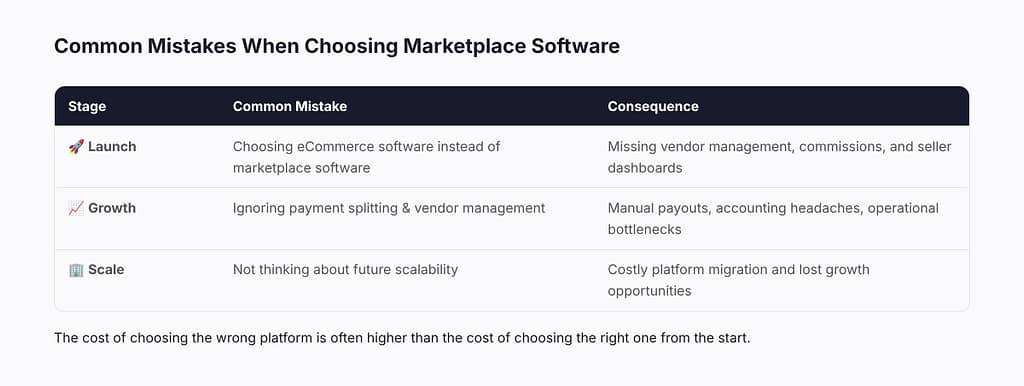
Choosing an eCommerce Platform Instead of Marketplace Software
Many businesses start by evaluating traditional eCommerce platforms because they’re already familiar with them. However, managing multiple vendors requires functionality that standard online store software often lacks.
Vendor onboarding, commission management, seller dashboards, moderation tools, and marketplace-specific workflows are usually not built into standard eCommerce platforms. Adding these features later can become expensive and difficult to maintain.
Ignoring Payment Splitting and Vendor Management
Marketplace operations are fundamentally different from running a single online store.
When multiple vendors participate in a transaction, payments often need to be split automatically, commissions calculated, and payouts distributed correctly. Without proper marketplace payment infrastructure, financial operations quickly become a manual process that consumes valuable time and increases the risk of errors.
Vendor management tools are equally important. As the marketplace grows, onboarding, communication, performance tracking, and product moderation become increasingly difficult without dedicated marketplace functionality.
Underestimating Migration and Scalability Limits
Many founders choose a platform based on today’s requirements rather than tomorrow’s goals.
A solution that works well with 20 vendors may struggle when the marketplace reaches 200 vendors. Similarly, businesses often discover limitations when expanding internationally, launching B2B capabilities, integrating ERP systems, or adding multiple storefronts.
Before committing to a platform, consider how easily it can support future growth. The cost of choosing a platform that can’t scale is often much higher than the cost of selecting the right platform from the beginning.
Frequently Asked Questions
What is the best marketplace platform for a small business?
The best marketplace platform depends on your business goals, technical resources, and growth plans. For most small businesses, the ideal solution combines ease of use, vendor management tools, payment automation, and scalability. Platforms such as Multi-Vendor by CS-Cart, Sharetribe, and Shopify marketplace solutions are popular starting points, while businesses planning long-term growth often prefer platforms with greater customization and ownership options.
Can I build a marketplace without coding?
Yes. Many modern marketplace platforms offer no-code or low-code solutions that allow founders to launch without hiring developers. These platforms typically include vendor onboarding, product management, payment processing, and marketplace administration tools out of the box. However, custom business requirements may eventually require development support as the marketplace grows.
How much does marketplace software cost?
Marketplace software costs vary significantly depending on the platform and business requirements. SaaS solutions often start with monthly subscription fees, while self-hosted platforms typically require a one-time license plus hosting and development costs. In addition to software expenses, businesses should consider implementation, integrations, customization, and ongoing maintenance when calculating total cost of ownership.
Which platform is easiest to scale?
Scalability depends on both the platform architecture and the business model. Platforms designed specifically for marketplaces generally provide a smoother path to growth than traditional eCommerce platforms enhanced with third-party apps. Businesses expecting rapid expansion should evaluate vendor limits, API capabilities, infrastructure flexibility, and migration paths before making a decision. It’s equally important to review the platform’s flexibility and determine whether it can support future operational needs. Businesses operating software marketplaces or digital product ecosystems should pay particular attention to API flexibility and customization options.
What features should a small business prioritize?
Most small businesses should focus on vendor management, commission automation, payment splitting, inventory management, analytics, integrations, and scalability. These features have the greatest impact on daily operations and help reduce manual work as the marketplace grows. It’s often better to choose a platform that supports future expansion than one that only solves today’s problems.
Still have questions about launching a marketplace? Our team can help you evaluate platforms, estimate costs, and choose the best solution for your business goals.
Final Thoughts
Launching a marketplace can be one of the most effective ways for small businesses to expand product offerings, create new revenue streams, and build a scalable business model. The challenge isn’t finding marketplace software—it’s choosing a platform that will continue supporting your business as it grows.
The best marketplace platforms combine ease of launch with long-term flexibility. Whether you’re building your first marketplace, adding vendors to an existing online store, or planning a multi-vendor ecosystem across multiple markets, it’s important to think beyond today’s requirements and consider where your business will be in three to five years.
A platform that supports automation, integrations, vendor management, and future growth can save significant time, money, and operational complexity down the road.
Ready to launch or scale your marketplace? Talk to our marketplace experts and get personalized recommendations based on your business model, growth plans, and technical requirements.

eCommerce expert with 10+ years of experience in marketplace management and consumer behavior. Gayane tracks the latest industry trends to provide businesses with analytical, actionable insights.