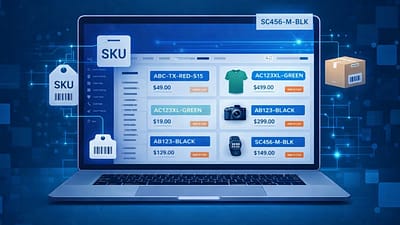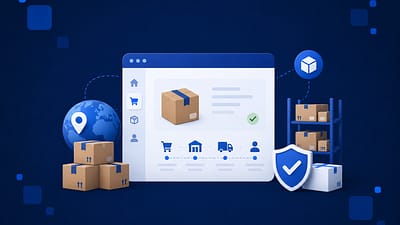
EAN barcodes remain one of the most widely used product identification standards in 2026, supporting billions of scans every day across retail, warehousing, healthcare, manufacturing, and eCommerce supply chains. These seemingly simple black-and-white stripes are a backbone of modern trade, logistics, and automation. Without them, retail and warehouse operations would be almost impossible.
CS-Cart helps integrate EAN barcodes efficiently, synchronize stock, and automate marketplace imports, reducing errors and supporting growth.
– Correct implementation reduces errors, speeds up operations, and improves marketplace compliance.
– CS-Cart simplifies EAN management with native support, add-ons, and flexible workflows, enabling scalable integration for stores and marketplaces.
What Is an EAN Barcode and Why Is It Important?
EAN (European Article Number) is a standard international product identifier printed as a barcode on product packaging. It enables instant product recognition, provides information about its origin, and tracks its journey from manufacturer to customer.
An EAN (European Article Number) is a unique numeric code assigned to each product variant. It helps retailers, marketplaces, and warehouses identify products quickly, synchronize stock, and prevent errors in inventory and fulfillment.
EAN codes are used in over 100 countries and are a critical part of global supply chains.
Today, EAN barcodes are used not only for retail checkout but also for inventory tracking, warehouse management, omnichannel fulfillment, and product traceability. They help synchronize product data across online stores, marketplaces, ERP systems, WMS platforms, and physical retail locations.
EAN barcodes play a central role in product identification, helping retailers, marketplaces, and inventory systems recognize products consistently across different regions and sales channels.
EAN, UPC, and Barcodes — What’s the Difference?
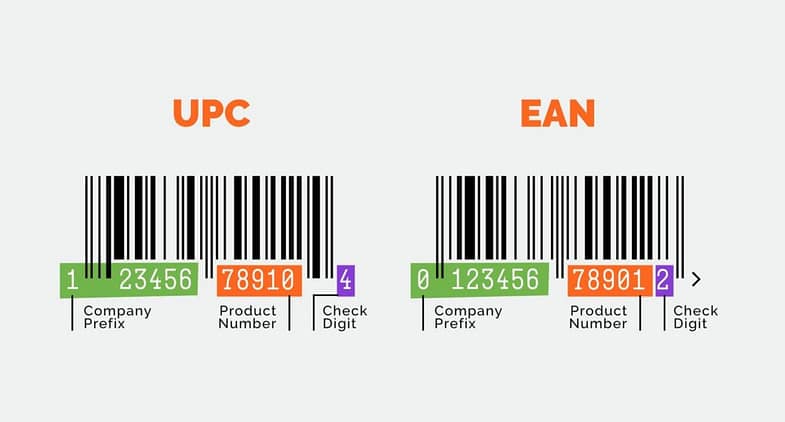
Although EAN, UPC, and “barcode” are often used interchangeably, they are different:
- Barcode — a general term for all machine-readable codes consisting of bars and spaces.
- UPC (Universal Product Code) — a 12-digit barcode format used mainly in the U.S. and Canada.
- EAN — a European standard compatible with UPC, but more common outside North America. The most used format is EAN-13 (13 digits).
In short: EAN and UPC are both barcode formats, but EAN dominates outside North America.
Read more: What is SKU: Meaning for Business, Examples, How to Use
Comparison of Common Barcode Standards
| Feature | EAN-13 | UPC-A | GS1-128 (EAN-128) |
|---|---|---|---|
| Digits | 13 | 12 | Variable (data + AI prefixes) |
| Main Use Regions | Europe, Asia, Latin America, Africa | United States, Canada | Global (logistics, healthcare, warehousing) |
| Compatibility | Fully compatible with UPC-A | Compatible with EAN (leading zero added) | Not for POS scanning; logistics only |
| Primary Purpose | Retail product identification | Retail product identification | Supply chain data (batch, expiry, serial number) |
| Example Prefixes | 400–440 (Germany), 690–699 (China), 890 (India) | N/A (UPC managed by GS1 US) | Uses Application Identifiers (AIs) such as (01) for GTIN and (17) for expiration date. |
| Marketplaces Accepting | Amazon, eBay, Lazada, Shopee, Carrefour, Tesco | Amazon US/CA, Walmart, Target | Backend logistics, not customer-facing |
Types of EAN Barcodes
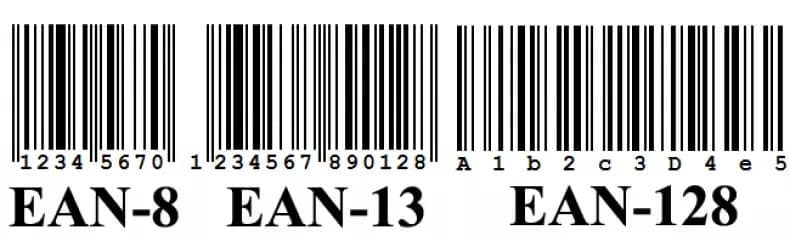
- EAN-13 — 13 digits; standard format for most products.
- EAN-8 — 8 digits; for small items with limited space.
- GS1-128 (EAN-128) — includes extra data for logistics (batch, expiry, weight, etc.).
Structure of EAN Codes
| EAN Type | Digits | Use Case |
|---|---|---|
| EAN-13 | 13 | Standard products |
| EAN-8 | 8 | Small items |
| GS1-128 | Variable | Logistics (batch, expiry, serial, weight) |
EAN-13
- 3 digits — GS1-assigned country/regional prefix (does not indicate manufacturing location).
- 4–5 digits — manufacturer code.
- 5–4 digits — product code (unique to manufacturer).
- 1 digit — check digit.
Example prefixes:
- 400–440 — Germany
- 690–699 — China
- 890 — India
- 500–509 — United Kingdom
EAN-8
- 2–3 digits — country or company prefix.
- 4–5 digits — product code.
- 1 digit — check digit.
GS1-128 (EAN-128)
- Can include multiple variables (serial number, expiry date, etc.)
- Uses Application Identifiers (AIs) such as (01) for GTIN, (17) for expiration date.
How to Calculate the EAN-13 Check Digit
- Add digits in odd positions (1st, 3rd, 5th, etc.).
- Add digits in even positions, multiply by 3.
- Add both sums.
- Round up to the nearest multiple of 10.
- Subtract your total from that number — this is the check digit.
How to Get an Official EAN Code
The only way to get globally recognized EAN barcodes is through GS1, the nonprofit that manages barcode standards.
To obtain an official EAN, register with your local GS1 member organization. This ensures your codes are globally recognized and accepted by major marketplaces.
- Register with your local GS1 member organization:
- Obtain a company prefix.
- Create unique product codes using your prefix.
If you sell on Amazon, eBay, Walmart, Lazada, Shopee, or major retailers, you’ll need official GS1 codes.
Generating EAN Barcodes for Internal Use or Testing
You can create EANs yourself for non-retail purposes:
- Choose a 12-digit number.
- Calculate the check digit.
- Use an online generator:
Finding Product Information by Barcode
Suppose you have a physical store and an online marketplace (online store). You want a customer who visits your offline location to be able to scan a product’s barcode and go to its page on the digital platform. In this case, inform the customer in advance about the opportunity to learn more about the product, for example, through services such as:
- Google Lens — scans and identifies products.
- Barcode Scanner (Android), QRbot (iOS) — reads product details.
- Barcode Lookup — global barcode database.
Using EAN Barcodes in eCommerce
In Your Online Store
EAN helps with:
- Unique product identification.
- Auto-filling product attributes from databases.
- Synchronizing stock with ERP/WMS.
- Reducing returns and shipping mistakes.
In Marketplaces
EAN codes are required by marketplaces such as Amazon, eBay, Walmart, Lazada, and Shopee to list products. Proper EAN integration in CS-Cart ensures automatic attribute import, reduces duplicate listings, and helps maintain compliance across multiple sales channels. Benefits:
- Avoids duplicate listings.
- Speeds up listing approval.
- Enables automatic attribute import.
- Reduces return/fulfillment errors.
- Speeds up warehouse operations.
- Ensures marketplace compliance.
- Improves SEO with consistent product data.
With proper product identification, labeling, and packaging in place, integrating products with online marketplaces becomes seamless. Accurate EANs support automatic attribute import, reduce duplicate listings, and improve compliance with marketplace requirements.
EAN Barcodes in Warehousing and Fulfillment
Beyond eCommerce storefronts, EAN barcodes play a critical role in warehouse operations. Modern fulfillment centers use barcode scanning during receiving, putaway, picking, packing, shipping, and inventory audits. Accurate barcode data reduces manual entry errors, improves inventory visibility, and helps businesses maintain accurate stock levels across multiple sales channels.
Using EAN Barcodes in CS-Cart
CS-Cart supports EAN barcodes both natively and via add-ons, enabling global product identification in your store.
Adding EAN to Products
To add an EAN field to products in CS-Cart, there are common approaches:
- Use Product Features. You can add an EAN as a product feature. This is a standard method but may have limitations. For example, it does not support product combinations and requires entry for each language individually.
- Use Marketplace Add-ons. There are add-ons like “Product Import Match EAN,” which use EAN as a key for matching products during import to avoid duplicates. The “Product Search By Barcode” add-on also allows managing products with EAN codes and supports barcode scanning.
- Customize the Product Data Structure. You can add a separate EAN field by modifying the CS-Cart database and templates. This involves adding a “product_ean” field to the cscart_products table and editing backend product. If you are unsure whether to customize the platform yourself, contact the CS-Cart team for professional development and integration support.
Best Practices
- One unique EAN per product variant.
- Validate before import.
- Include on shipping labels and picking lists.
- Use standardized product labeling to ensure barcode readability.
- Use barcode scanners with CS-Cart POS/admin.
CS-Cart simplifies product identification and inventory management with EAN codes. Contact our team to discuss how you can integrate barcodes efficiently into your online store or marketplace.
Conclusion
Implementing a reliable barcode system with EAN codes is essential for any eCommerce business aiming to reduce errors, improve warehouse operations, and ensure marketplace compliance. CS-Cart provides a robust platform to manage EAN barcodes efficiently, whether for your own store or when selling on major marketplaces. For businesses looking to fully customize their CS-Cart platform and optimize EAN integration, the CS-Cart team provides both a flexible platform and custom development services to tailor the system to your inventory, logistics, and marketplace needs.
FAQ about EAN
What is an EAN barcode?
EAN (European Article Number) is a standardized product identifier printed as a barcode on packaging, enabling instant recognition and tracking across stores and marketplaces.
How do EAN barcodes differ from UPC?
UPC is a 12-digit code mainly used in the U.S. and Canada. EAN is compatible with UPC but more common globally, with EAN-13 being the standard for most products outside North America.
Why are EAN barcodes important for online marketplaces?
EANs prevent duplicate listings, speed up approvals, enable automatic attribute imports, reduce fulfillment errors, and ensure compliance with marketplace requirements.
How can I add EAN barcodes in CS-Cart?
You can add EANs using product features, marketplace add-ons like “Product Import Match EAN” or by customizing the product data structure with a dedicated product_ean field.
Can I manage EAN barcodes efficiently at scale?
Yes. CS-Cart provides built-in support, add-ons, and flexible workflows to integrate EAN barcodes, synchronize stock, and automate marketplace imports, reducing errors and supporting growth.

eCommerce expert with 10+ years of experience in marketplace management and consumer behavior. Gayane tracks the latest industry trends to provide businesses with analytical, actionable insights.