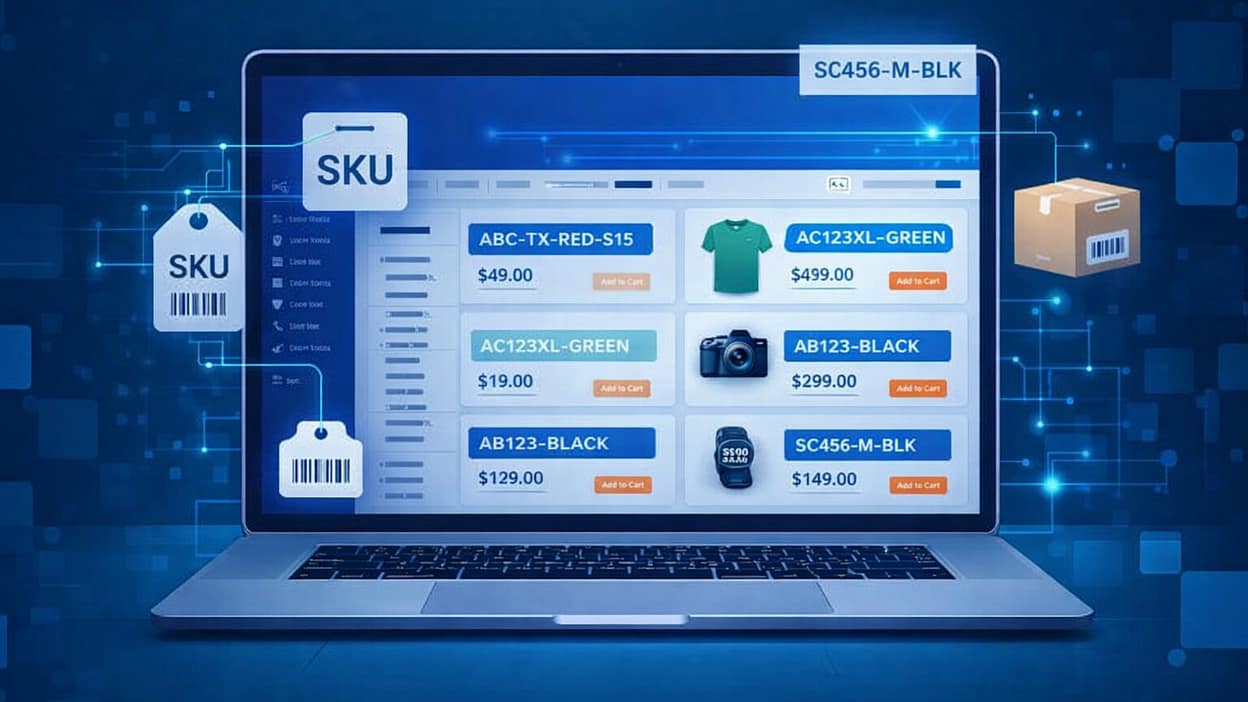
SKU systems became widely adopted by retailers as inventory management processes evolved throughout the 20th century. Today, SKUs are used across a wide range of industries, including retail, manufacturing, and eCommerce. Let’s see how you can implement SKUs in your business.
While the concept of SKUs has existed for decades, they remain essential in 2026 as businesses manage inventory across online stores, marketplaces, warehouses, and multiple sales channels.
Managing thousands of SKUs across products, variants, warehouses, and sales channels requires the right inventory infrastructure. CS-Cart helps businesses organize SKU data, track inventory in real time, and manage complex product catalogs from a single platform.
– SKUs help retailers, manufacturers, and marketplace sellers organize product catalogs, improve inventory accuracy, reduce fulfillment errors, and analyze sales data across sales channels.
– In online stores and marketplaces, SKUs simplify the management of product variations, inventory synchronization, and real-time stock tracking, and platforms like CS-Cart include built-in tools to manage SKUs efficiently.
What Does SKU Stand For?
The SKU acronym stands for Stock Keeping Unit. It is a unique identifier assigned to a product by a vendor, distributor, or manufacturer for the purpose of inventory tracking. SKU codes typically consist of a combination of numbers and letters that identify the product’s characteristics, such as color, size, style, and packaging. They can be used in various industries, including retail stores, eCommerce, and manufacturing to keep track of inventory levels, sales performance, pricing, and promotions.
Parts of SKU Number
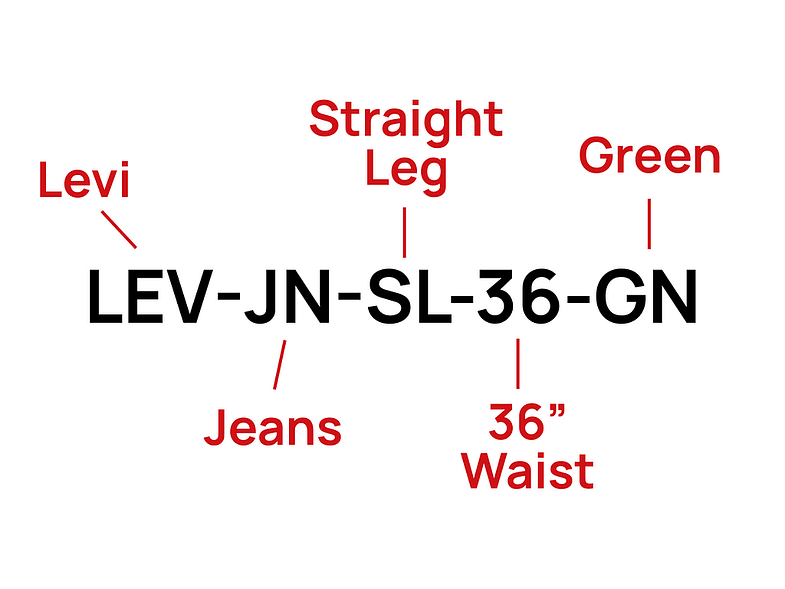
SKU numbers are composed of a combination of letters and numbers, and each digit or letter represents specific information about the product, such as its size, color, manufacturer, or price.
For example, a pair of Levi’s green straight-leg jeans in size 36 might have a SKU number such as LEV-JN-SL-36-GN. The SKU number helps distinguish this particular product from other jeans in different colors or sizes, making it easier to manage inventory and sales data.
Or WJ-1234-M-RED. In this example, WJ represents the brand, 1234 is the product code, M denotes medium size, and RED indicates the color.
SKUs vs. Other Product Identifiers
SKU vs UPC
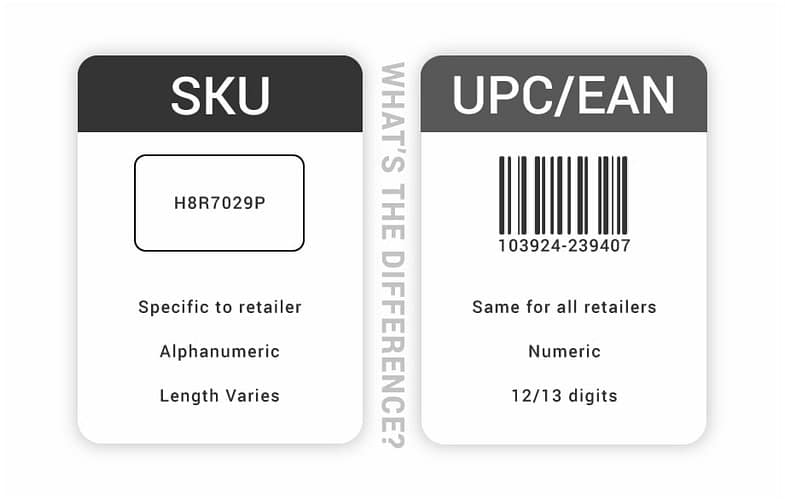
The Stock Keeping Unit (SKU) and Universal Product Code (UPC) are both codes used in retail to identify products, track stocks, and manage sales and pricing.
Product SKUs are unique alphanumeric codes used by a retailer to identify and differentiate products. Retailers create them to help manage their inventory and track sales.
UPC, on the other hand, is a standardized barcode system used to identify products globally. The manufacturer assigns it and includes a 12-digit number that represents the product and its features. UPCs are used to scan products at the point of sale, track items, and improve supply chain management.
While both SKU and UPC are used for inventory tracking, they serve different purposes. SKU tracking in retail can be used to monitor internal inventory and sales, while UPCs, which manufacturers apply, are used to track products throughout the supply chain.
SKU in retail helps manage inventory, track sales, and improve overall operations for retailers.
SKU vs ASIN vs UPC vs GTIN
Although these identifiers are often used together, they serve different purposes. A SKU is an internal code created by a retailer or marketplace seller for inventory management. A UPC is a globally recognized barcode assigned to a product by the manufacturer. GTIN (Global Trade Item Number) is the international standard behind UPC and EAN codes. ASIN (Amazon Standard Identification Number) is Amazon’s proprietary product identifier used within its marketplace.
Businesses often use all four identifiers simultaneously. For example, a product may have a manufacturer-assigned UPC, an Amazon ASIN, and a custom SKU created by the retailer for internal inventory tracking.
| Identifier | Created By | Purpose | Example |
|---|---|---|---|
| SKU | Retailer or seller | Internal inventory management | TSH-BLK-M-001 |
| UPC | Manufacturer | Product identification and barcode scanning | 012345678905 |
| GTIN | GS1 | Global product identification standard | 00012345678905 |
| ASIN | Amazon | Product identification within Amazon | B0ABC12345 |
| Serial Number | Manufacturer | Tracking individual items | SN-987654321 |
SKU vs Serial Numbers
SKU codes are usually alphanumeric and can be customized by the company.
A serial number, on the other hand, is a unique identifier assigned to each item within a specific product line. It is used to track the item’s history, warranty, and other details related to the product’s manufacturing and distribution. Serial numbers are usually numeric and are assigned by the manufacturer.
SKU vs Barcode vs Part Number
SKU, Barcode, and Part Number are all codes used in inventory management to identify products.
SKU is a unique identifier assigned by a retailer to a specific product. It is used to track stock unit levels and sales.
A barcode is a series of lines and spaces that represent a product’s unique identifier. It can be scanned using online barcode scanner to quickly and accurately identify the product.
A Part Number is a unique identifier assigned by a manufacturer to a specific product. It is used to track inventory levels and production.
In summary, SKU is used by retailers, barcode is used for scanning, and manufacturers use part number.
SKUs and POS Systems
SKUs are unique identification codes used to track and manage stock. Each product has its own SKU assigned to it, which helps in managing and simplifies the process of ordering and stocking products. You may also come across EAN barcodes, which serve as standardized international identifiers complementing SKUs in global retail.
POS (Point of Sale) systems, on the other hand, are software and hardware systems used at checkout to process transactions, manage inventory, and generate reports.
SKUs and POS systems work together to provide retailers with accurate and timely sales data, enabling them to make data driven business decisions.
Why Are Stock Keeping Units Important to Business
Retailers like Amazon use SKUs to manage vast inventories efficiently, ensuring accurate order fulfillment and personalized recommendations. Research analyzing more than 24,000 SKUs across retail stores found that inventory record inaccuracies directly affect product availability and sales performance, while inventory audits can increase store-wide sales by up to 11% (arXiv).
Let’s examine the reasons for embedding the SKU system in an online business.
Role of SKUs in Customer Experience
In online retail, SKUs help ensure accurate order assembly and allow eCommerce platforms to recommend related products or substitutes for out-of-stock items. This further personalizes the customer experience (CX) and helps businesses build brand loyalty and increase customer retention.
Role of SKUs in Supply Chain Management
SKUs are essential for tracking the precise location and movement of products across warehouses, distribution centers, and retail outlets. They serve as unique identifiers, functioning like a GPS for inventory. This allows businesses to know exactly where each item is stored at any moment. This level of detail is crucial for efficient order processing, accurate inventory management, and transparent supply chain management, particularly for businesses with multiple warehouses or complex distribution networks.
Modern warehouse management systems rely on SKU-level inventory tracking to automate replenishment, optimize picking routes, and maintain real-time visibility across multiple storage locations. SKUs also facilitate automated reordering, help prevent stockouts and overstocking, and streamline logistics from manufacturer to end customer.
Role of SKUs in Inventory Management
SKUs form the foundation of effective inventory management. They help businesses track stock levels, maintain inventory accuracy, organize product catalogs, and synchronize inventory across multiple sales channels. As product catalogs grow, many businesses combine SKU management with a PIM system to centralize product information and maintain data consistency across sales channels. A well-structured SKU inventory system also supports inventory control, reduces stock discrepancies, and helps prevent both stockouts and overstocking. As product assortments grow, SKUs become essential for scalable stock management and operational efficiency.
Role of SKUs in Marketing
SKUs provide granular sales data that marketers can use to identify high-performing products, spot trends, and optimize promotional strategies. SKU meaning in sales goes beyond inventory tracking. Sales teams use SKU-level data to analyze product performance, identify top-selling items, forecast demand, and optimize pricing strategies.
By analyzing SKU-level sales reports, businesses can identify the most popular items, tailor marketing campaigns accordingly, and adjust their inventory to meet consumer demand. SKUs also enable targeted promotions, such as highlighting fast-selling products or offering discounts on slow-moving items. They support cross-selling and upselling by recommending related items during the customer journey.
Key Benefits of Using SKUs
- Efficient Inventory Management. SKUs enable real-time tracking of stock levels, reduce errors, and simplify the restocking process.
- Accurate Order Fulfillment. They minimize picking and packing mistakes, ensuring customers receive the correct products.
- Enhanced Data Analysis. SKU data offers actionable insights into sales trends, product performance, and customer preferences.
- Streamlined Omnichannel Operations. SKUs help synchronize inventory across ecommerce stores, marketplaces, warehouses, and physical locations, ensuring accurate stock levels, reducing discrepancies, and improving inventory visibility across all sales channels.
- Increased Profits. By optimizing stock levels and marketing efforts, SKUs help maximize sales and reduce losses from unsold inventory.
Where SKUs Are Used in Business Operations
SKUs are applied throughout various business functions, including:
- Retail Stores. For inventory tracking, shelf organization, and customer service.
- Warehouses and Distribution Centers. To manage stock locations, streamline order picking, and facilitate logistics.
- eCommerce Platforms. For product catalog management, product variant organization, order fulfillment, and cross-channel inventory synchronization.
- Marketing and Sales. To analyze product performance, plan promotions, and personalize customer interactions.
- Supply Chain Management. For tracking goods from suppliers to customers, optimizing logistics, and automating reordering processes.
SKUs are fundamental to modern commerce. They drive efficiency, accuracy, and customer satisfaction across all areas of business.
Once SKUs become part of inventory management and warehouse operations, the next challenge is creating a SKU structure that remains scalable as the product catalog grows.
How SKUs Support Multichannel Selling
Modern businesses often sell through multiple channels, including their online store, marketplaces, social commerce platforms, and physical retail locations. SKUs help connect these channels by serving as a consistent product identifier across systems.
Accurate SKU management also supports fulfillment and logistics workflows, especially when managing shipping on an eCommerce marketplace with multiple vendors, warehouses, and sales channels.
Best Practices for Generating Product SKUs
Generating SKUs may be overwhelming, but it is not the case if you follow simple rules:
- Keep it concise and meaningful. A good SKU is usually a combination of letters and numbers that make sense within the context of the product it represents. It should be short enough to be easily remembered and written down, yet long enough to be distinctive.
- Use a consistent format. Your SKUs should follow a consistent format across your entire inventory. This will make it easier to sort, search and retrieve products when needed.
- Avoid using special characters and spaces. Special characters and spaces can cause issues when importing or exporting data or when trying to search for products in a database. Avoid starting SKUs with zeros, as some systems may omit them. Also, refrain from using characters that can be easily confused, like “O” and “0” or “I” and “1”.
- Ensure uniqueness. Each SKU should be unique for each product in your inventory to avoid duplicates, overlaps, or confusion.
- Length. Most businesses keep SKUs between 6 and 12 characters to balance readability and scalability.
- Be specific. Use descriptive words in the SKU to make it easier to identify the product.
- Avoid repetition. Don’t repeat letters or numbers in the SKU.
- Plan for future growth. Consider the scalability of your SKU system as your business grows.
Here are some examples of the best SKU formats:
- A combination of letters and numbers (e.g., ABC123)
- A sequential numbering system (e.g., 1, 2, 3)
- A product code based on categories and subcategories (e.g., WD01 or FNS001)
Common Mistakes in SKU Management and How to Avoid Them
| Mistake | Description | How to Avoid |
|---|---|---|
| Overcomplicating SKU Structure | Creating SKUs that are too long, complex, or overloaded with information, making them hard to use and prone to errors | Keep SKUs short (8-12 characters), logical, and consistent; avoid unnecessary details and ambiguous characters |
| Inconsistent Naming Conventions | Using different formats or structures for SKUs across products or channels, leading to confusion and errors | Establish and enforce a standardized naming convention for all SKUs, and train staff accordingly |
| SKU Proliferation | Creating too many SKUs, especially for minor product variations, resulting in inventory clutter and increased carrying costs | Regularly review SKU performance, rationalize the catalog, and phase out underperforming or redundant SKUs |
| Neglecting SKU Updates | Failing to update SKUs as the product catalog evolves, causing mismatches and inaccurate inventory data | Schedule periodic audits and updates to ensure SKUs reflect current inventory and business needs |
| Lack of Integration Across Systems | Having SKUs that differ between inventory, sales, and POS systems, leading to fulfillment errors and data mismatches | Integrate all systems and automate SKU mapping to maintain consistent SKU data everywhere |
| Using Problematic Characters | Including zeros at the start, special characters, or ambiguous letters (like “I” and “l”) that can cause technical or human errors | Avoid starting SKUs with zeros, using special characters, and choose characters that are easily distinguishable |
| Insufficient Staff Training | Employees not understanding SKU conventions or system processes, resulting in operational mistakes | Provide comprehensive onboarding and ongoing inventory management training for all staff involved in inventory management |
By following these integration steps and avoiding common pitfalls, businesses can optimize SKU management, resulting in more accurate inventory tracking, improved fulfillment, and better informed decision-making.
SKU Examples
Let’s see some examples of SKUs:
- Nike Air Jordan’s shoes: AJ1234-567 (a SKU containing letters and numbers)
- Apple iPhone 16 Pro: A16-BLK-256GB (a SKU that includes model name, color, and storage capacity)
- Walmart’s Great Value Canned Corn: 12345 (a simple SKU that is just a number)
- SKU for an item could be “SHOES-001” for a pair of shoes, where “SHOES” represents the category and “001” means a unique identifier for that specific product.
– TSH = T-shirt
– BLK = Black
– M = Medium
– 001 = Product identifier
This SKU instantly tells employees what the product is without needing to open a product record. Businesses often create SKU formats based on product category, color, size, brand, or other attributes relevant to inventory management.
What Is SKU on Facebook Marketplace?
If you sell products on Facebook Marketplace, you may notice a field called SKU when creating a listing. On Facebook Marketplace, SKU stands for Stock Keeping Unit and works as an internal product identifier that helps sellers organize inventory, track sales, and manage product variations.
For example, a seller might assign the SKU “FBM001” to a pair of shoes listed on Facebook Marketplace. They can then use this SKU to track stock availability, monitor sales, and distinguish the product from similar listings. While casual sellers may leave the SKU field empty, businesses often use SKUs to synchronize inventory across Facebook Marketplace, online stores, marketplaces, and inventory management systems.
SKU-based inventory management is a standard feature of modern marketplace platforms, where thousands of products and variants must be tracked across multiple sellers.
How Can Customers Find a SKU Number?
Not all customers are aware of special numbers. However, for an online business owner, it is crucial to explain to their future or current clients the value of knowing SKUs and where to seek them.
Customers may use a SKU to find a specific item they previously saw on social media, in a printed catalog, or in a physical store where direct product links are unavailable. Try to explain some common places to find SKU:
- Product packaging or label – most products have a SKU number on their packaging or label. A series of numbers and letters is usually located near the barcode.
- Product listing online – the SKU number may be listed in the product description or specifications.
- Purchase receipt – the SKU number may be listed on the purchase receipt or invoice.
- Product catalog –the SKU numbers may be listed in the product catalog.
SKU Customization
Customizing SKUs can also help businesses distinguish between similar products or track products with different attributes, such as size or color.
Let’s explore some ideas for SKU customization:
- Using a combination of letters and numbers to create a unique code for each product. For example, a t-shirt could have the SKU “TS01BLK” (for black) or “TS02RED” (for red).
- Including attributes in the SKU code, such as size, material, or product type. For example, a dress could have the SKU “DR01MLVS” (for a medium-sized, sleeveless dress).
- Using sequential numbers as part of the SKU code to indicate when a product was added to inventory. For example, a new t-shirt could have the SKU “TS2026001,” indicating it was added to inventory in 2026.
Overall, the goal of SKU customization is to create a system that is easy to use and understand for both businesses and customers.
How to Integrate SKUs with Inventory Management Systems
Integrating SKUs with inventory management systems involves several key steps to ensure accurate tracking, streamlined operations, and data consistency:
- Develop a Logical SKU Structure. Start by creating a clear and consistent SKU format that incorporates relevant product attributes, such as category, size, and color, and is easy to understand and scale as your product range expands.
- Assign SKUs to All Products. Every product and its variants should be assigned a unique SKU to ensure that no duplicates exist.
- Implement Inventory Management Software (IMS). Choose an IMS that supports automated SKU generation, barcode scanning, and real-time inventory updates across all channels. The system should integrate seamlessly with your sales platforms (e.g., Shopify, Amazon) and other business tools.
- Centralize Data Management. Utilize a centralized system to synchronize SKU data across all platforms, ensuring consistency in stock levels and product information, and minimizing manual errors.
- Support Real-Time Inventory Visibility. Ensure your inventory management system provides real-time SKU inventory updates across online stores, marketplaces, warehouses, and physical locations. This helps maintain accurate stock levels, prevent overselling, and improve inventory control across all sales channels.
- Automate Inventory Synchronization. Use tools that provide real-time updates on inventory as sales and returns occur, thereby preventing overselling and stock discrepancies.
- Regularly Audit and Update SKUs. Conduct routine audits to remove obsolete or duplicate SKUs and ensure that SKU data aligns with physical inventory and naming conventions.
How to Create Product SKU Numbers
There are several tools available that can be used to create product SKUs, such as:
- SKU Labs – a software solution that automates inventory, order, and shipping management. It also features a custom SKU creation tool for products.
- Zoho Inventory – an SKU management software that comes with a SKU generator feature. This tool helps create custom SKUs for products and their variants.
- QuickBooks – digital accounting software that also includes an inventory management feature. It allows users to create custom SKUs for products.
- Cin7 Core (formerly DEAR Systems) – inventory management software with SKU tracking, barcode support, and purchasing automation.
A Platform With Built-In SKUs
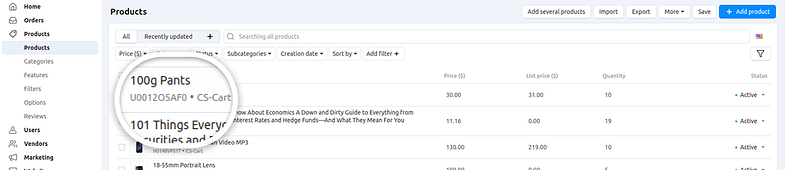
CS-Cart offers SKU options built-in. The platform provides digital entrepreneurs with robust SKU management features designed to streamline product organization and inventory control:
- Manual and Automatic SKU Assignment. Merchants can choose to manually assign SKUs to products or utilize CS-Cart’s auto-generation feature, allowing for consistency and efficiency in SKU creation.
- Per-Option SKUs. Each product variant, such as different sizes or colors, can have its own unique SKU. This granularity aids in precise inventory tracking and management.
- Product Variations as Separate SKUs. CS-Cart treats each product variation as a distinct item, assigning it a unique SKU, which facilitates detailed sales analysis and inventory control.
- Bulk Editing Capabilities. The platform allows for bulk editing of SKUs through the admin panel or via import/export tools, making it easier to manage extensive inventories.
- Advanced Inventory Tools. In a multi-vendor setup, each vendor can independently manage their SKUs, ensuring accurate stock levels and reducing administrative overhead.
If you run a CS-Cart-based store, SKUs can be added to your products when you create them or imported in bulk using a CSV file.
CS-Cart also provides integration services for advanced SKU management. We can connect your eCommerce website with a SKU management platform of your choice and help synchronize inventory across systems.
These solutions are particularly useful for stores with large product catalogs or multivendor marketplaces. CS-Cart’s experience as both a platform provider and integration partner helps businesses build scalable inventory management workflows.
FAQ about SKU
What does SKU stand for?
SKU stands for Stock Keeping Unit. It is a unique product identifier businesses use to track inventory, monitor sales, manage product variations, and organize product catalogs.
What is the difference between a SKU and a UPC?
A SKU is an internal code created by a retailer or marketplace to manage inventory, while a UPC (Universal Product Code) is a standardized identifier assigned by a manufacturer and used globally for product recognition and barcode scanning.
Why are SKUs important in inventory management?
SKUs help businesses maintain accurate inventory records, track stock levels in real time, prevent stockouts and overstocking, improve order accuracy, and streamline warehouse operations.
What is a SKU in a marketplace?
In a marketplace, a SKU is used to identify and manage individual products and product variants. SKUs help sellers and marketplace operators synchronize inventory, track sales performance, and maintain accurate stock levels across multiple vendors and sales channels.
What does SKU mean on Facebook Marketplace?
On Facebook Marketplace, a SKU is an optional product identifier that sellers can use to organize listings, track inventory, and distinguish products from similar items. It is especially useful for businesses managing multiple listings or selling across several channels.
How do businesses create SKU numbers?
Most businesses create SKU numbers using a structured format that includes product attributes such as category, brand, size, color, or model. A consistent SKU system makes products easier to identify, track, and manage as the catalog grows.
Can two products have the same SKU?
No. Each SKU should be unique within a business’s inventory system. Using duplicate SKUs can lead to inventory errors, inaccurate sales reports, fulfillment mistakes, and stock management issues.
Conclusion
SKUs may seem like simple product codes, but they play a critical role in modern business operations. From inventory management and stock control to product catalog organization and sales analysis, SKUs help businesses maintain accuracy, improve efficiency, and make better decisions.
Whether you run an online store, sell on marketplaces, or manage inventory across multiple sales channels, a well-structured SKU system makes it easier to track products, reduce fulfillment errors, and scale operations as your catalog grows.
As eCommerce becomes increasingly multichannel in 2026, effective SKU management remains one of the foundations of accurate inventory tracking, streamlined operations, and a better customer experience.

eCommerce expert with 10+ years of experience in marketplace management and consumer behavior. Gayane tracks the latest industry trends to provide businesses with analytical, actionable insights.