
In most cases, businesses start with a single online store, but as they grow, they often discover that their existing platform becomes a limitation rather than an advantage. Expanding into B2B sales, launching multiple storefronts, creating a marketplace, or integrating complex business systems requires a different level of flexibility and scalability. This is where choosing the right eCommerce platform becomes a strategic business decision.
The shift toward more complex commerce models is accelerating. According to Forrester, online marketplaces now account for approximately 63.5% of global eCommerce sales, generating around $4.7 trillion in GMV, while global online retail sales have surpassed $7 trillion. In this environment, choosing the right eCommerce solution from the start can directly affect a company’s ability to expand into new business models and compete effectively in the future.
In this article, we compare Squarespace and CS-Cart Multi-Vendor to help you determine which platform is better suited for your current needs and long-term expansion plans without a disruptive migration later.
2. The biggest difference is scalability. Squarespace can support simple eCommerce operations with minimal setup, but marketplace features often require third-party tools and custom workarounds. CS-Cart Multi-Vendor includes vendor management, marketplace automation, commission systems, and multi-storefront capabilities out of the box, making it better suited for marketplace expansion.
3. The right choice depends on your business model. Choose Squarespace if you need an easy-to-manage website or online store. Choose CS-Cart Multi-Vendor if your roadmap includes marketplaces, B2B commerce, vendor ecosystems, advanced integrations, or plans to scale without migrating to a new platform later.
Squarespace vs CS-Cart Multi-Vendor: Quick Overview
Both platforms serve very different business goals.
Squarespace is a website builder with built-in eCommerce functionality designed for entrepreneurs, creators, and small businesses that want to launch a professional-looking website and sell products online with minimal setup.
CS-Cart Multi-Vendor is a dedicated marketplace platform built for businesses that want to manage multiple vendors, automate marketplace operations, launch B2B portals, create multi-storefront ecosystems, and scale without the limitations of traditional website builders.
For companies planning long-term growth, the key difference is not design flexibility or ease of setup. Many businesses comparing CS-Cart Multi-Vendor and Squarespace are ultimately evaluating marketplace scalability against website simplicity. The real question is whether the platform can support increasingly complex business models as the company expands.
What Is Squarespace?

Squarespace is a SaaS website builder that combines website design, content management, and eCommerce functionality in a single platform. As a fully hosted platform, Squarespace manages hosting, security updates, maintenance, and infrastructure on behalf of merchants while delivering reliable performance and fast load times.
It offers professionally designed templates, drag-and-drop editing, built-in hosting, and basic online store features. Businesses can use template customization tools to modify layouts, branding elements, typography, and page structures without coding. The platform also includes built-in SEO tools that help businesses optimize pages, products, and content for search engines. This makes it a popular choice for small businesses, consultants, creators, and brands launching their first online store.
While Squarespace provides everything needed to sell products directly to customers, its eCommerce functionality is primarily designed for a single merchant operating a single store. As a shopping cart software platform, it focuses on product management, order processing, payments, and customer purchases rather than supporting marketplace operations.
What Is CS-Cart Multi-Vendor?
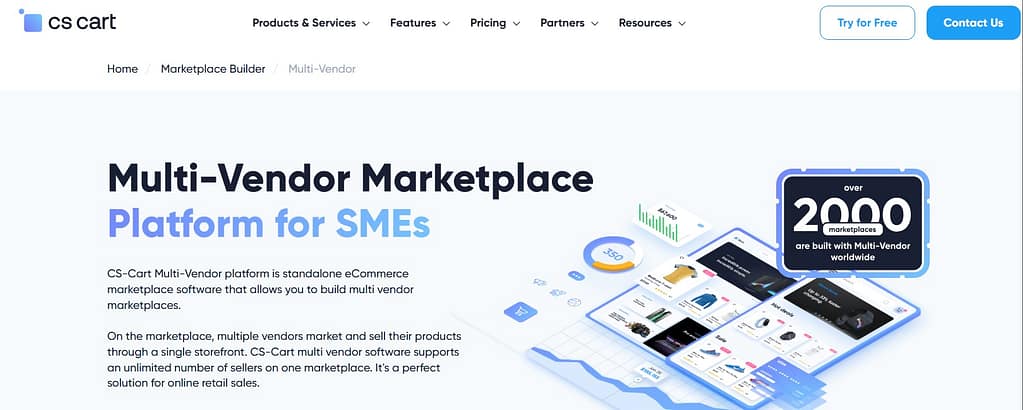
CS-Cart Multi-Vendor is a marketplace software solution that allows multiple independent vendors to sell through a single platform. While traditional shopping cart software is designed for a single merchant, CS-Cart Multi-Vendor extends this model with built-in marketplace capabilities that support multiple vendors, commissions, and marketplace operations. As a self-hosted platform, CS-Cart gives businesses full control over infrastructure, hosting providers, data ownership, and software customization.
Unlike traditional eCommerce platforms, CS-Cart Multi-Vendor uses a multi-seller architecture where independent vendors operate through a shared marketplace infrastructure. The platform includes vendor management, seller onboarding, commission systems, vendor dashboards, payout management, marketplace administration tools, and multi-vendor catalog management out of the box.
It is designed for businesses that want to launch online marketplaces, B2B procurement portals, dealer networks, franchise ecosystems, wholesale platforms, or multi-storefront commerce operations from a centralized system. These businesses often build a complete marketplace ecosystem where vendors, buyers, administrators, payment providers, and logistics partners interact through a single platform.
Can You Build a Marketplace with Squarespace?
Technically, yes. However, building a marketplace with Squarespace requires significant workarounds, custom development, or third-party services because the platform was not originally designed for multi-vendor commerce.
A specialized marketplace website builder eliminates many of these limitations by providing marketplace functionality, vendor tools, and operational workflows out of the box.
This distinction becomes important as the number of vendors, products, orders, and operational processes grows.
How Squarespace Marketplace Solutions Work
Most marketplace implementations on Squarespace rely on custom forms, external databases, manual vendor management processes, or integrations with third-party marketplace tools. Some businesses attempt to extend functionality using a Squarespace marketplace plugin or a third-party Squarespace marketplace app, although these solutions typically rely on external services rather than native marketplace architecture.
In practice, the platform acts as a storefront while core marketplace operations are handled outside of Squarespace.
This approach can work for small directories, curated product collections, or niche marketplaces with a limited number of sellers.
Does Squarespace Support Multiple Vendors?
Squarespace does not provide native multi-vendor functionality.
Vendors cannot create accounts, manage their own products, process orders, view sales statistics, or update inventory through dedicated seller dashboards.
As a result, marketplace operators typically become responsible for managing vendor information, product uploads, inventory updates, and order coordination manually or through custom integrations.
Marketplace Limitations of Squarespace
As a marketplace grows, several limitations become increasingly noticeable:
- No native vendor dashboard functionality
- No built-in commission management
- No automated vendor payouts
- No marketplace order splitting
- No vendor-specific inventory management
- Limited workflow automation for marketplace operations
- Dependence on third-party tools for marketplace functionality
For businesses planning to scale beyond a small number of vendors, these limitations can create significant operational overhead and increase the need for manual management.
Learn more about marketplace building process from these guides:
- What Is a Marketplace Platform? Definition, Features, and Use Cases
- How to Create an eCommerce Marketplace from Scratch
Marketplace Features Compared
The biggest distinction between Squarespace and CS-Cart Multi-Vendor appears when comparing the features required to operate a marketplace efficiently. The following key features highlight where the two platforms differ most for marketplace businesses.
Vendor Onboarding and Management
Vendor management is one of the most important components of a successful marketplace.
With Squarespace, vendor onboarding typically requires manual approval processes, spreadsheet tracking, custom forms, and external communication workflows.
CS-Cart Multi-Vendor includes a complete vendor management system out of the box. Marketplace owners can approve sellers, configure vendor plans, manage permissions, review applications, monitor performance, and communicate with vendors from a centralized administration panel.
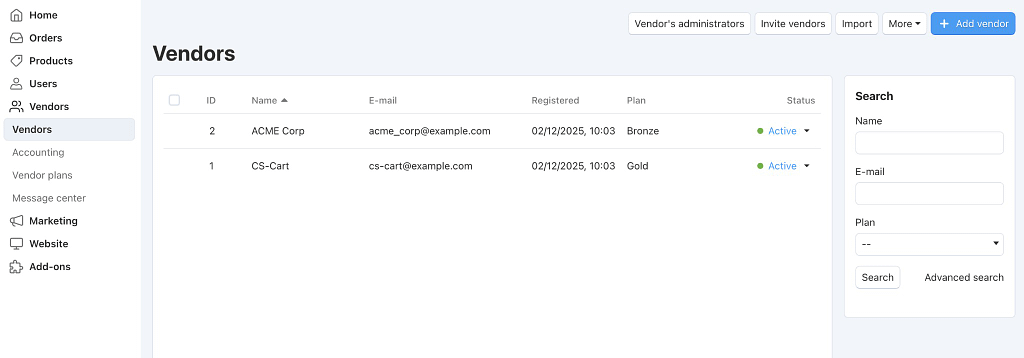
Each vendor receives a dedicated dashboard where they can manage products, inventory, orders, shipping settings, and business information independently.
Learn more about vendor management from:
- Marketplace Seller Onboarding: How to Attract and Retain Vendors
- How to Control eCommerce Marketplace Vendors
Commission and Split Payments
Marketplace revenue models often depend on automated commission collection and vendor payouts. Marketplace platforms must efficiently manage buyer-seller transactions, ensuring commissions, payouts, and order processing are handled accurately and transparently.
Squarespace does not provide native marketplace commission management. Marketplace operators usually need custom payment workflows or external solutions to calculate commissions and distribute payments.
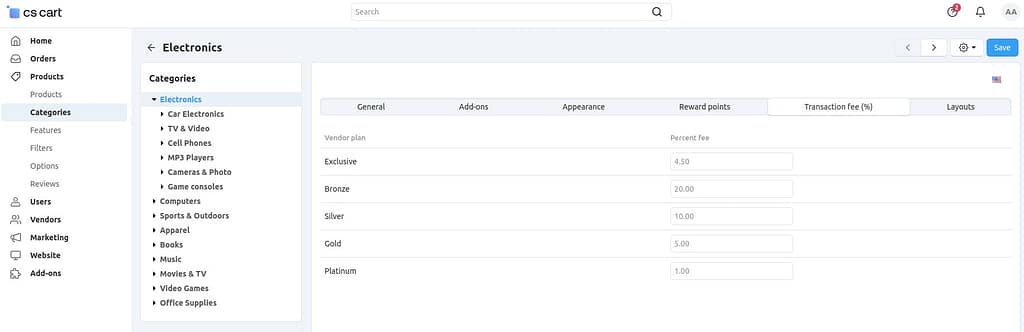
CS-Cart Multi-Vendor includes built-in marketplace monetization tools. Administrators can configure commission rates, vendor plans, subscription fees, transaction fees, category-based commissions, and payout rules.
When combined with supported payment providers, the platform can automate significant portions of the marketplace payment process, reducing administrative work and improving financial transparency.
Get more insights about marketplace payment configuration from:
- Marketplace Payments & Fees: Everything You Need to Know
- Split Payments for Marketplaces: Benefits, Challenges, and Best Practices
- Best Marketplace Payment Solutions for Multi-Vendor Platforms
Product Catalog and Inventory Management
Managing products from multiple sellers becomes increasingly complex as a marketplace grows.
Squarespace was designed around a single merchant inventory model. Managing large multi-vendor catalogs often requires additional manual processes and custom workflows.
CS-Cart Multi-Vendor was built specifically for multi-vendor catalog management. Vendors can independently add products, update inventory, manage product variations, upload content, and monitor stock levels while administrators maintain centralized oversight.

This approach reduces operational bottlenecks and allows marketplaces to scale product catalogs without proportionally increasing administrative workload.
Get more insights from:
Efficient Inventory Management for E-commerce Success: Tips and Best Practices
Order Management and Checkout
Order processing becomes more challenging when multiple vendors participate in the same transaction.
Squarespace handles standard eCommerce checkout efficiently for single-store operations but does not provide marketplace-specific order management capabilities.
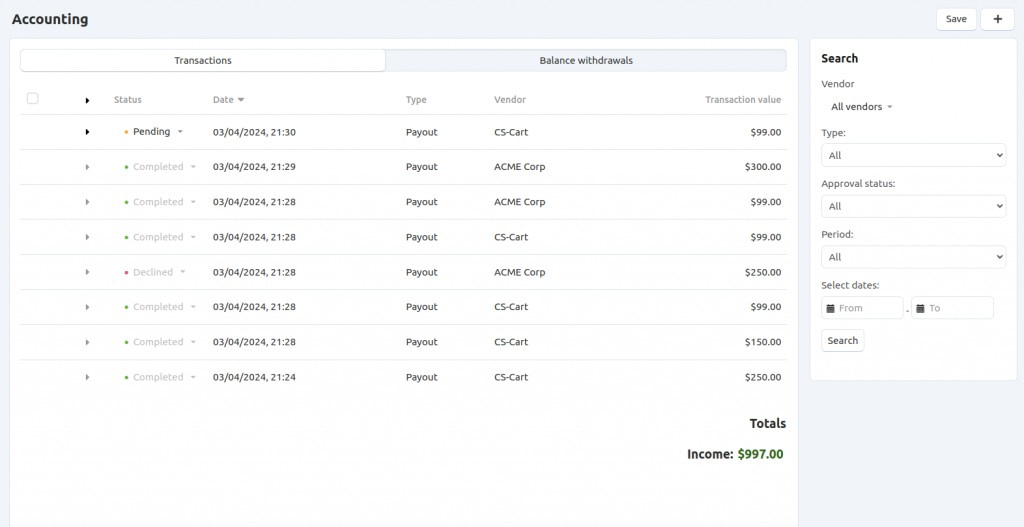
CS-Cart Multi-Vendor supports marketplace order workflows, including vendor-specific order processing, marketplace administration controls, vendor notifications, commission tracking, and marketplace reporting.
As order volume increases, these capabilities help automate routine processes and reduce the amount of manual coordination required between marketplace operators and vendors.
You may also be interested in reading:
- Marketplace Order Management: How to Automate and Scale Marketplace Operations
- Seamless Checkout: 7 Best Practices for Faster and Frictionless Payments
- eCommerce Checkout Process: Types, Steps & Best Practices
Customization, Integrations, and Scalability
As businesses grow, platform requirements often shift from launching a website to building an operational ecosystem. Integrations, automation, custom workflows, and scalability become increasingly important when managing multiple sales channels, vendors, teams, and business processes.
Apps and Marketplace Extensions
Squarespace offers a growing ecosystem of integrations and extensions that help businesses connect marketing, shipping, accounting, and customer management tools. For many small businesses, these integrations provide enough functionality to streamline daily operations without requiring technical expertise.
However, businesses with highly specific marketplace requirements may eventually encounter limitations because many marketplace features must be added through third-party apps, external services, or custom workarounds.
CS-Cart Multi-Vendor takes a different approach. Core marketplace functionality is included in the platform itself, and additional capabilities can be added through a large ecosystem of marketplace-focused add-ons, extensions, and integrations.
This allows marketplace operators to extend functionality without replacing core systems as business requirements evolve.
API Integrations and Custom Development
Most growing eCommerce businesses eventually need to connect their platform with ERP systems, CRM software, accounting tools, warehouse management systems, shipping providers, marketing platforms, or custom business applications.
Squarespace supports integrations through APIs and third-party services, but custom development opportunities remain limited compared to open-code platforms. Businesses typically work within the boundaries established by the SaaS environment.
CS-Cart Multi-Vendor provides open access to the platform code, APIs, database structure, and core application logic. This access allows developers to create custom integrations and build industry-specific functionality. This gives companies significantly more flexibility when implementing custom workflows, complex integrations, B2B functionality, vendor-specific processes, or industry-specific requirements. This flexibility makes the platform suitable for businesses that require deep customization and industry-specific workflows.
For businesses that expect their operational processes to become more sophisticated over time, this flexibility can become a major advantage.
Scalability and Headless Commerce
Scalability is not just about handling more traffic. It also involves supporting new business models, additional vendors, larger product catalogs, more integrations, and increasingly complex operational processes.
Squarespace scales well for traditional online stores and content-driven websites. However, businesses pursuing marketplace models, multi-storefront operations, B2B commerce, or advanced automation may eventually outgrow the platform’s intended use case.
CS-Cart Multi-Vendor is designed for long-term marketplace growth. Businesses can start with a relatively small marketplace and gradually expand into multi-vendor ecosystems, regional storefronts, B2B portals, wholesale operations, and complex marketplace networks.
For organizations pursuing advanced digital commerce strategies, Enterprise eCommerce Solution also supports headless commerce architectures, allowing businesses to separate the front-end experience from the marketplace backend while maintaining centralized management. These capabilities make the platform suitable for both growing marketplaces and large enterprises with complex operational requirements.
Pricing Comparison
Initial software costs only tell part of the story. Businesses should also consider implementation costs, operational efficiency, future customization requirements, and the likelihood of needing a platform migration later.
Squarespace Pricing
Squarespace uses a subscription-based pricing model with hosting, security, maintenance, and updates included.
Squarespace pricing starts with the Basic plan at $12 per month ($144 per year), which includes essential website-building tools, payment processing, online selling capabilities, and marketing features.
However, businesses building marketplace functionality may need additional third-party services, custom development, or external tools that increase overall costs over time.
CS-Cart Multi-Vendor Pricing
CS-Cart Multi-Vendor is available in both subscription and self-hosted licensing models.
Unlike general-purpose website builders, the platform includes marketplace-specific functionality such as vendor management, commissions, seller dashboards, vendor plans, marketplace administration tools, and multi-vendor catalog management.
CS-Cart Multi-Vendor pricing starts with the Standard plan at $725 per year, which includes core marketplace functionality, vendor management tools, full source code access, and Customer Care with installation and update services.
For businesses planning to launch a marketplace, many features that would otherwise require custom development are available out of the box.
Total Cost of Ownership
When comparing costs, businesses should look beyond monthly subscription fees.
The total cost of ownership includes:
- Marketplace functionality implementation
- Third-party software subscriptions
- Custom development
- Operational efficiency
- Platform migration costs
- Ongoing maintenance and support
| Platform | Plans & Pricing | 3-Year TCO* |
| Squarespace | Basic — $144/year Core — $204/year Advanced — $300/year | Basic: $432 Core: $612 Advanced: $900 |
| CS-Cart Multi-Vendor | Standard — $725/year Plus — $1,449/year Ultimate — $3,599/year | Standard: $2,175 Plus: $4,347 Ultimate: $10,797 |
Additional costs such as hosting, custom development, third-party apps, integrations, and premium services are not included.
Direct price comparisons should be viewed with caution. Squarespace is designed primarily for websites and online stores, while CS-Cart Multi-Vendor is a dedicated marketplace platform that includes vendor management, commissions, payouts, seller onboarding, and multi-vendor functionality out of the box. For a growing marketplace, CS-Cart Multi-Vendor can become more cost-effective because all the marketplace-specific capabilities are already included in the platform, reducing the need for multiple external services and extensive custom development.
Learn more about the cost breakdown of marketplace building from:
- The Total Cost of Ownership of eCommerce Software Explained
- How Much Does It Cost to Build a Marketplace Website?
Squarespace vs CS-Cart Multi-Vendor: Pros and Cons
Squarespace Pros & Cons for Marketplaces
CS-Cart Multi-Vendor Pros & Cons
Who Should Choose Squarespace?
Squarespace is an excellent solution for businesses whose primary goal is launching and managing a professional online presence with straightforward eCommerce capabilities.
Best for Small Businesses and Simple Online Stores
Squarespace works particularly well for:
- Local businesses
- Independent brands
- Content-driven businesses
- Service providers
- Creators and entrepreneurs
- Small online stores with a single seller
For these organizations, ease of use often outweighs the need for advanced marketplace functionality.
When Squarespace Is the Right Choice
Squarespace is likely the right choice if:
- You operate a single online store
- You do not need third-party sellers
- You prioritize design simplicity and ease of use
- You want a fully managed SaaS solution
- You prefer not to invest heavily in technical resources or internal development teams.
- You have limited customization requirements
- You are not planning to launch a marketplace, B2B portal, or multi-storefront ecosystem
Who Should Choose CS-Cart Multi-Vendor?
CS-Cart Multi-Vendor is designed for businesses that view their eCommerce platform as a long-term growth asset rather than simply a website.
Best for Multi-Vendor Marketplaces
CS-Cart Multi-Vendor is a strong fit for:
- Online marketplaces
- Industry-specific marketplaces
- B2B marketplaces
- Wholesale platforms
- Vendor ecosystems
- Dealer and distributor networks
- Franchise commerce models
The platform includes the infrastructure needed to onboard vendors, automate operations, manage commissions, and scale marketplace activity from a single administration panel.
Best for Businesses Planning to Scale
CS-Cart Multi-Vendor becomes particularly attractive when businesses are asking questions such as:
- How can we launch a marketplace without building everything from scratch?
- How can we automate vendor operations?
- How can we support multiple storefronts and business models?
- How can we integrate ERP, CRM, warehouse, and accounting systems?
- How can we avoid another platform migration in a few years?
If your growth strategy includes marketplace expansion, B2B commerce, multi-storefront operations, automation, or advanced integrations, CS-Cart Multi-Vendor provides a foundation that can evolve alongside your business rather than forcing you to rebuild as complexity increases.
Related Resources:
- Best Multi-Vendor Marketplace Platforms and Software in 2026
- Shopify vs CS-Cart: Which Platform Is Better for Building an Online Store in 2026?
- Sharetribe vs CS-Cart: Which Marketplace Platform Is Better for Growth?
Final Verdict
Squarespace and CS-Cart Multi-Vendor are designed for very different business goals. The best choice depends on your unique needs, business model, growth plans, and customization requirements.
Use Squarespace if you’re building a tiny curated shop with 1–3 vendors where you manually add all products and handle payouts yourself. The software provides an easy-to-use environment, attractive templates, and all the tools needed to sell products online as a single merchant.
However, if your business strategy includes launching a marketplace, onboarding multiple vendors, building a B2B portal, creating multiple storefronts, automating operations, or integrating complex business systems, CS-Cart Multi-Vendor is the more suitable solution. For businesses evaluating a Squarespace competitor for marketplace development, CS-Cart Multi-Vendor offers marketplace-specific functionality that would otherwise require multiple third-party tools and custom workarounds.
As your business grows, marketplace features such as vendor management, commissions, vendor dashboards, marketplace automation, and advanced integrations become increasingly important.
For businesses that want to avoid platform limitations and future migrations, CS-Cart Multi-Vendor offers the flexibility and scalability needed to support future expansion.
Ready to launch and grow your own marketplace? Explore the full capabilities of CS-Cart Multi-Vendor and see how it can support your business as it grows. Request a free consultation to discuss your marketplace requirements and growth plans.
FAQ
Can you build a multi-vendor marketplace with Squarespace?
Technically, yes, but not natively. Squarespace does not include built-in marketplace functionality such as vendor dashboards, commission management, vendor onboarding, or marketplace order processing. Most marketplace implementations require custom development, third-party services, or manual workflows.
What are the main limitations of Squarespace for marketplace businesses?
The biggest limitations include the lack of native vendor management, commission systems, split payments, marketplace-specific inventory management, vendor dashboards, and marketplace automation tools. As the number of vendors and transactions grows, these limitations can increase operational complexity.
What is the best Squarespace alternative for building a marketplace?
For businesses that want to launch a dedicated multi-vendor marketplace, CS-Cart Multi-Vendor is one of the strongest Squarespace marketplace alternatives for businesses that want to launch and scale a multi-vendor platform. Unlike website builders, it is specifically designed for marketplace operations and includes vendor management, marketplace monetization tools, commission systems, and marketplace administration features out of the box.
Is CS-Cart Multi-Vendor self-hosted or cloud-based?
CS-Cart Multi-Vendor is available in both self-hosted and cloud-based deployment options. Businesses can choose the model that best matches their technical requirements, customization needs, and growth plans.
Does CS-Cart Multi-Vendor support vendor commissions and split payments?
Yes. CS-Cart Multi-Vendor includes built-in commission management tools that allow marketplace owners to charge transaction fees, vendor subscription fees, category-based commissions, and other marketplace monetization models. The platform also supports integrations with payment providers that enable automated split payment workflows.
Can I migrate from Squarespace to CS-Cart Multi-Vendor?
Yes. Businesses frequently migrate from website builders and traditional eCommerce platforms to CS-Cart Multi-Vendor when they need marketplace functionality, greater customization, or more advanced business workflows. A typical migration can include products, customers, orders, content, and other business data. If you’re planning a migration project and want to discuss your requirements with marketplace experts, contact the CS-Cart team to evaluate your options and migration strategy.
Which platform is better for scaling a marketplace business?
For marketplace growth, CS-Cart Multi-Vendor is the stronger choice. It was specifically designed to support multiple vendors, marketplace automation, marketplace monetization, large product catalogs, advanced integrations, and complex business models. Squarespace can work well for traditional online stores, but it was not built to manage the operational requirements of a growing marketplace.
Which platform is better for long-term eCommerce growth?
The answer depends on your business goals.
If you plan to operate a single online store with relatively simple requirements, Squarespace may provide everything you need.
If your roadmap includes launching a marketplace, adding B2B capabilities, managing multiple storefronts, integrating ERP and CRM systems, or supporting a growing vendor network, CS-Cart Multi-Vendor offers significantly greater flexibility and scalability for long-term growth.

eCommerce expert with 10+ years of experience in marketplace management and consumer behavior. Gayane tracks the latest industry trends to provide businesses with analytical, actionable insights.