Shopify Payments is one of the biggest reasons businesses choose Shopify—and, for some, one of the main reasons they eventually leave it. While it eliminates the need to connect a third-party payment gateway, reduces transaction fees, and gives merchants access to accelerated checkouts like Shop Pay and local payment methods, its limited country availability and platform lock-in can become significant obstacles as businesses expand internationally or migrate to another eCommerce platform.
However, Shopify Payments isn’t available everywhere. As of 2026, merchants can use it in 39 countries and regions, leaving businesses in many parts of Asia, Africa, Latin America, and the Middle East to rely on third-party payment providers instead.
For growing businesses, country availability is only one piece of the puzzle. Businesses engaged in cross-border commerce must also consider payment availability, local banking requirements, and regional regulations before entering new markets. If you’re planning international expansion, launching B2B sales, or migrating to another eCommerce platform in the future, it’s important to understand both the advantages and the limitations of Shopify Payments.
In this guide, you’ll find the complete Shopify Payments supported countries list for 2026, learn which countries have been added recently, who is eligible to use Shopify Payments, where the service is still unavailable, and what payment alternatives you can choose if your business operates outside Shopify’s supported regions.
2. Eligibility depends on more than your location. Businesses must meet Shopify’s country, banking, identity verification, and compliance requirements before they can activate Shopify Payments.
3. Think beyond today’s payment setup. Since Shopify Payments only works within the Shopify ecosystem, businesses planning international expansion or future platform migrations should consider payment flexibility and long-term scalability from the start.
What Is Shopify Payments?
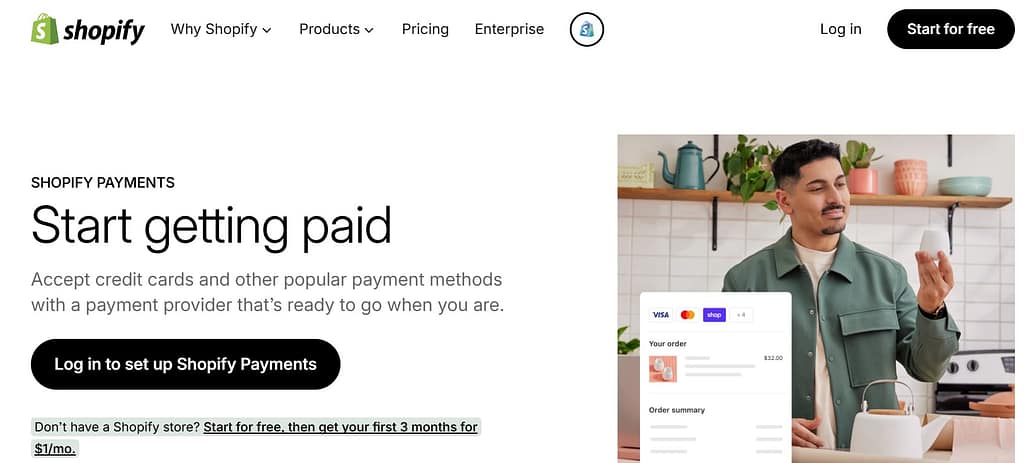
Shopify Payments is Shopify’s built-in payment processing solution. Instead of connecting an external gateway like Stripe or Authorize.Net, merchants can start accepting online payments directly from their Shopify admin. Most payment settings can be configured directly from the Shopify admin without installing additional software. This simplifies the entire payment process by reducing the number of third-party services merchants need to configure.
The service supports:
- major credit and debit cards;
- Apple Pay;
- Google Pay;
- Shop Pay;
- selected local payment methods;
- and Buy Now, Pay Later options in supported markets.
One of its biggest advantages is simplified setup. Merchants don’t need to open a separate merchant account or create an account with a third-party payment processor, and all payment information, split payments, disputes, and reporting are managed from a single dashboard.
Another important benefit is pricing. Stores using Shopify Payments avoid Shopify’s additional third-party transaction fees that apply when using external gateways.
Learn more: 8 Best Marketplace Payment Solutions
Shopify Payments Supported Countries
Shopify continues expanding Shopify Payments into new markets, although availability still covers only a portion of countries where Shopify itself can be used.
As of June 2026, Shopify Payments is available in 39 countries and regions. Only businesses registered in Shopify Payments eligible countries can activate the service and receive payouts through the platform. This list reflects the latest Shopify Payments availability by country and region. Businesses registered outside supported countries can still build a Shopify store, but they’ll need to use one of Shopify’s eligible third-party payment gateways instead.
Merchants can create a Shopify store almost anywhere in the world, even if Shopify Payments is not yet available in their country.
Countries Where Shopify Payments Is Available
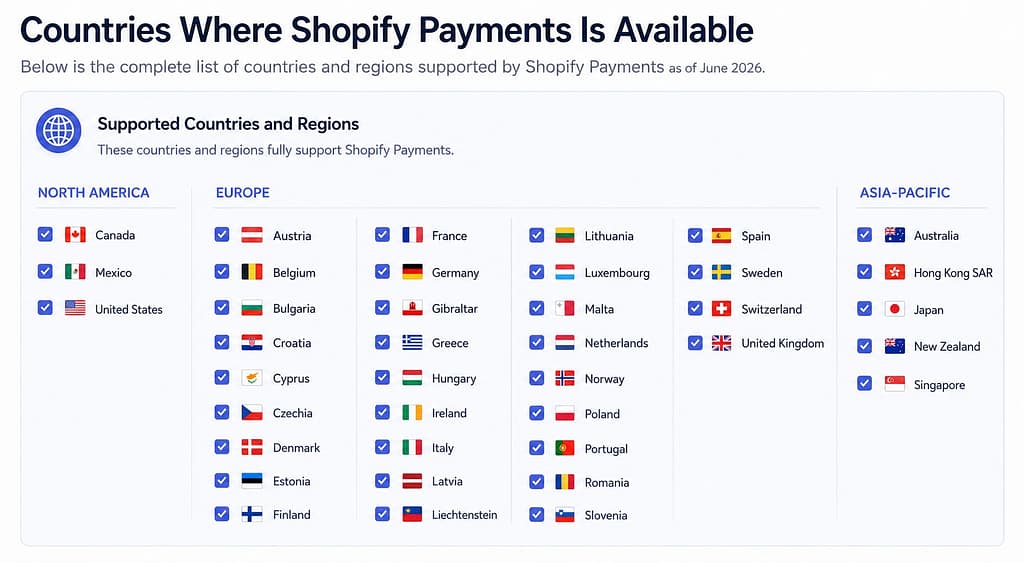
Below is the complete list of countries supported by Shopify Payments as of June 2026:
North America
- Canada
- Mexico
- United States
Europe
- Austria
- Belgium
- Bulgaria
- Croatia
- Cyprus
- Czechia
- Denmark
- Estonia
- Finland
- France
- Germany
- Gibraltar
- Greece
- Hungary
- Ireland
- Italy
- Latvia
- Liechtenstein
- Lithuania
- Luxembourg
- Malta
- Netherlands
- Norway
- Poland
- Portugal
- Romania
- Slovenia
- Spain
- Sweden
- Switzerland
- United Kingdom
Asia-Pacific
- Australia
- Hong Kong SAR
- Japan
- New Zealand
- Singapore
This Shopify Payments availability list is updated whenever Shopify launches the service in additional countries and regions, so merchants should always check the latest availability before registering a business in a new country.
Recently Added Supported Countries
Shopify significantly expanded Shopify Payments during 2025 by enabling support in several new European markets, including Poland, Norway, Greece, Hungary, Latvia, Lithuania, Croatia, Estonia, Malta, Mexico, and Slovenia. Throughout late 2025 and early 2026, support continued expanding across additional EU countries such as Bulgaria, Cyprus, Luxembourg, and others, bringing the total number of supported countries to 39. Shopify continues expanding into new supported markets, although payment availability still lags behind Shopify’s global store availability.
The expansion reflects Shopify’s broader strategy of strengthening its payments ecosystem across Europe, making it easier for merchants in newly supported countries to use native checkout features instead of third-party gateways.
Regional Breakdown
Shopify Payments’ availability is heavily concentrated in developed eCommerce markets.
| Region | Availability | Notes |
|---|---|---|
| North America | Excellent | Full support in the US, Canada, and Mexico. |
| Europe | Excellent | Most EU countries, the UK, Switzerland, Norway, and Liechtenstein are supported. |
| Asia-Pacific | Limited | Available only in Australia, New Zealand, Japan, Singapore, and Hong Kong SAR. |
| Latin America | Very limited | Mexico is currently the only supported country. |
| Middle East | Very limited | The UAE is supported, while most neighboring countries are not. |
| Africa | Very limited | Most African countries cannot use Shopify Payments. |
These regional restrictions can affect expansion plans, especially for businesses entering emerging markets where Shopify Payments is not yet supported. For companies planning international expansion, this regional coverage matters. While Shopify itself can be used almost anywhere, payment processing depends on whether Shopify Payments—or a suitable third-party gateway—is available in each target market.
If you’re expanding into unsupported countries, you’ll likely need to manage different payment providers across regions, which can increase operational complexity.
Countries Where Shopify Payments Is Not Available
Although Shopify Payments has expanded significantly, merchants in most countries worldwide still cannot use Shopify’s native payment processor.
Businesses registered in unsupported regions can still run a Shopify store, but they’ll need to connect one of Shopify’s third-party payment gateways instead. Depending on the country, this may also mean paying Shopify’s additional transaction fees when Shopify Payments isn’t available.
Unsupported Countries List
Rather than listing more than 150 unsupported countries individually, it’s more useful to understand the regions where Shopify Payments has limited or no coverage. The regions covered by Shopify Payments continue to expand each year, although many markets remain unsupported.
As of June 2026, Shopify Payments is not officially available in most countries across:
- Africa
- Central Asia
- South Asia (except selected markets)
- Southeast Asia (except Singapore)
- Most of the Middle East
- Most of Latin America (except Mexico)
- Eastern Europe outside Shopify’s supported markets
For example, merchants in countries such as India, Pakistan, Serbia, Egypt, Saudi Arabia, Kazakhstan, Indonesia, Vietnam, Brazil, Argentina, Nigeria, and South Africa must use third-party payment providers instead.
Why Shopify Payments Is Not Available in Some Regions
Payment availability isn’t determined by merchant demand alone.
Shopify Payments depends on several factors, including:
- financial regulations;
- banking infrastructure;
- payment licensing requirements;
- fraud prevention and compliance obligations;
- local Know Your Customer (KYC) rules;
- partnerships with regional financial institutions.
Many of these limitations are driven by compliance restrictions, including anti-money laundering regulations, Know Your Customer (KYC) requirements, and country-specific financial licensing rules.
Because Shopify operates its own integrated payment service, entering a new country requires substantial regulatory approval.
Shopify Payments Requirements and Eligibility
Being located in a supported country doesn’t automatically mean your business qualifies for Shopify Payments. Merchants must also satisfy Shopify’s verification, compliance, and banking requirements before payments can be activated.
Merchant Requirements
To use Shopify Payments, merchants generally must:
- register their business in a supported country;
- provide identity verification documents;
- be at least 18 years old (or have an eligible account representative);
- comply with local tax and financial regulations;
- enable two-step authentication for account security.
Shopify also evaluates businesses for financial compliance to ensure merchants meet local banking, tax, and anti-fraud regulations.
Restricted Businesses and Industry Limitations
Shopify maintains a list of restricted businesses that cannot use Shopify Payments because of legal or regulatory requirements. Not every business model is eligible.
Shopify restricts or prohibits certain industries, including:
- gambling;
- firearms and regulated products;
- adult content;
- counterfeit goods;
- many financial services;
- certain cryptocurrency-related businesses;
- products requiring specialized regulatory approval.
Restrictions vary slightly by country, so merchants should review the policies applicable to their jurisdiction before applying. Merchants should follow Shopify’s latest documentation because eligibility requirements may change over time.
Bank Account Requirements
Merchants must also connect a bank account that meets Shopify’s local payout requirements.
Typically, this means:
- the account must be located in the same supported country as the Shopify Payments account;
- the payout currency must be supported;
- the account must accept electronic transfers;
- the business information submitted during verification must match the banking details.
These requirements are designed to simplify compliance and reduce fraud, but they also mean businesses can’t simply choose any country—they generally need a legally registered business and compatible banking infrastructure in one of Shopify Payments’ available markets.
One practical implication for growing businesses is that Shopify Payments is tied to the Shopify ecosystem. If you later migrate to another platform, you’ll need to replace Shopify Payments with a different payment gateway.
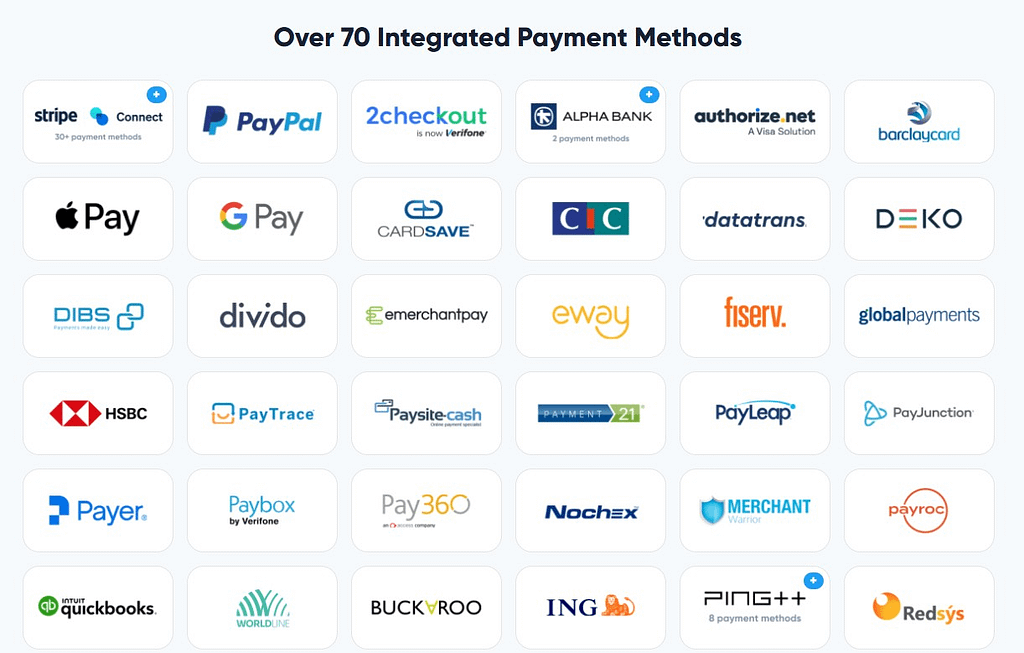
Platforms such as CS-Cart take a different approach by integrating with independent payment providers like Stripe, PayPal, Adyen, and 70+ payment methods and numerous regional gateways, allowing merchants to keep their payment processor regardless of the commerce platform they use.
After reviewing the Shopify Payments supported countries and fees, merchants can better estimate the total cost of accepting payments in their region.
Shopify Payments Fees and Payouts
Before enabling Shopify Payments, it’s important to understand how pricing works. The total cost depends on your Shopify subscription, the country where your business is registered, the customer’s payment method, and whether the payment is domestic or international.
Unlike many third-party gateways, Shopify Payments doesn’t charge a separate monthly fee. Instead, merchants pay payment processing fees for each transaction. One of its biggest financial advantages is that stores using Shopify Payments avoid Shopify’s additional transaction fees that apply when external payment gateways are used.
Processing Fees by Region
Processing fees vary by country because payment networks, local regulations, and banking costs differ from one market to another. Credit card processing costs also vary depending on the merchant’s Shopify plan, customer location, and payment method.
For example, merchants in the United States, the United Kingdom, Australia, and most European countries each have their own pricing schedules. Fees also differ for online payments, in-person transactions via Shopify POS, and manually entered card details.
Since Shopify periodically updates its pricing, merchants should always check the latest rates for their country before calculating operating costs. If you’re expanding internationally, remember that processing fees may differ between your domestic and foreign markets, affecting overall profitability. Businesses selling internationally through Shopify Markets should also review payment availability in each target country because supported payment methods and currencies vary by market.
You may also be interested in reading: Marketplace Payments & Fee Mechanics: How to Calculate Your Real Costs Before Launch
Transaction Fees by Shopify Plan
Your Shopify subscription directly affects payment processing costs.
Higher-tier plans generally offer lower card processing fees, making them more cost-effective for businesses with higher sales volumes.
This pricing structure makes higher-tier plans more attractive for businesses with increasing sales volumes.
It’s also worth noting that if you decide to use a third-party payment gateway instead of Shopify Payments, Shopify typically charges an additional platform transaction fee unless your plan or gateway arrangement qualifies for an exemption. When comparing providers, merchants should evaluate both payment gateway fees and Shopify’s own transaction fees to understand the total cost of accepting payments.
For growing businesses, it’s worth evaluating the total cost of ownership, not just card processing rates. Subscription costs, payment fees, paid apps, and integration expenses together determine the long-term cost of running your store.
Payout Schedules and Banking Support
Shopify Payments deposits funds directly into your connected bank account.
Payout schedules vary depending on your country and banking system. The settlement time also varies by country, local banking infrastructure, and the selected payment methods. Some regions receive payouts within one or two business days, while others have longer settlement periods.
Merchants can track:
- upcoming payouts;
- completed payouts;
- payment status;
- refunds;
- chargebacks;
- payment disputes;
directly from the Shopify admin.
To receive payouts, your bank account must:
- be located in the same country as your Shopify Payments account;
- support electronic transfers;
- match your verified business information.
Different countries may also have minimum payout thresholds or additional banking requirements.
Payment Methods Available with Shopify Payments
Shopify Payments supports a wide variety of payment methods designed to improve checkout conversion and provide customers with familiar ways to pay.
The exact options depend on the merchant’s country, customer location, and Shopify plan. Supported payment methods and currencies vary depending on the merchant’s country and Shopify configuration.
Cards and Digital Wallets
Most merchants using Shopify Payments can accept major international payment methods, including:
- Visa
- Mastercard
- American Express
- Discover (selected countries)
- Apple Pay
- Google Pay
- Shop Pay
These payment options are integrated directly into Shopify Checkout without requiring additional gateway configuration.
Shop Pay deserves particular attention because it has become one of Shopify’s key competitive advantages. By securely storing customer payment and shipping information, Shop Pay enables significantly faster repeat purchases and powers accelerated checkout experiences across Shopify’s growing commerce ecosystem.
Local Payment Methods
In addition to global card networks, Shopify Payments supports various local payment methods depending on the merchant’s country.
Examples include:
- iDEAL (Netherlands)
- Bancontact (Belgium)
- SEPA Direct Debit
- EPS (Austria)
- Sofort (selected European markets)
- Klarna and other Buy Now, Pay Later options where available
Offering alternative payments alongside traditional cards often improves conversion rates, particularly in regions where local payment methods dominate online shopping. Supporting local payment methods can improve conversion rates because customers are often more likely to complete purchases using payment options they already trust.
Available methods continue to expand as Shopify enters new markets.
What to Use If Shopify Payments Is Not Available
Many successful online businesses operate in countries where Shopify Payments isn’t supported. Fortunately, merchants have several payment alternatives, including global payment gateways and regional payment providers that support local banking systems.
However, choosing the right payment provider depends on your target markets, currencies, business model, and future growth plans.
Third-Party Payment Gateways
If Shopify Payments isn’t available in your country, Shopify allows merchants to connect supported external payment providers.
Popular options include:
- Stripe Connect
- PayPal Checkout
- Adyen
- Authorize.net
- 2Checkout (Verifone)
- Worldpay
- Mollie
- Braintree
Availability varies by country, and not every provider supports every market.
If you’re evaluating platforms beyond Shopify, this flexibility becomes even more important. Unlike Shopify Payments, which only works within the Shopify ecosystem, platforms such as CS-Cart integrate with numerous independent payment providers. This allows merchants to keep the same payment processor even if they migrate to a different eCommerce platform, reducing vendor lock-in and simplifying long-term growth.
Read more: Shopify vs CS-Cart Multi-Vendor: Which Platform Best Suits Your Marketplace Goals?
Regional Payment Alternatives for Different Countries
In many regions, local payment providers remain the preferred option.
Some examples include:
| Region | Common Payment Providers |
|---|---|
| North America | Stripe, PayPal, Authorize.net |
| United Kingdom | Stripe, PayPal, Worldpay |
| European Union | Stripe, Adyen, Mollie, PayPal |
| Australia & New Zealand | Stripe, eWAY, PayPal |
| India | Razorpay, PayU, Cashfree |
| Southeast Asia | Xendit, HitPay, 2C2P |
| Latin America | Mercado Pago, EBANX, dLocal |
| Middle East | PayTabs, HyperPay, Telr |
| Africa | Paystack, Flutterwave |
For businesses expanding internationally, choosing a platform that supports multiple payment gateways often provides greater flexibility than relying on a single proprietary payment solution.
Read also: Shopify Alternatives: 11 Best Free & Paid eCommerce Platforms in 2026
Should You Use Shopify Payments?
Shopify Payments works well for many businesses, but it’s not the right choice for every merchant. Here’s a quick way to decide:
| Yes, if… | No, if… |
|---|---|
| Your business is in a supported country. | Your business is outside a supported country. |
| You’re committed to Shopify. | You may switch platforms later. |
| You want a simple built-in payment solution. | You want maximum payment flexibility. |
| You want to avoid extra Shopify transaction fees. | You already use another payment provider. |
Conclusion
Shopify Payments is an excellent choice for merchants operating in one of its supported countries. For businesses located in countries that support Shopify Payments, the service offers one of the simplest ways to begin accepting online payments. It is one of the most widely used payment solutions for Shopify merchants around the world. It simplifies payment processing, integrates seamlessly with Shopify Checkout, and eliminates Shopify’s additional transaction fees associated with third-party gateways.
However, country availability remains one of its biggest limitations. Businesses registered outside Shopify’s supported markets must rely on external payment providers, and merchants planning future migrations should remember that Shopify Payments cannot be transferred to another eCommerce platform.
If your business expects to expand internationally, launch B2B sales, build multiple storefronts, or eventually operate a marketplace, it’s worth considering not only where Shopify Payments works today, but also how your payment infrastructure will scale as your business evolves.
Platforms like CS-Cart take a more flexible approach by supporting a wide range of independent payment providers, allowing merchants to choose the gateway that best fits their market while avoiding dependence on a single commerce ecosystem.
FAQ
Can I use Shopify Payments from an unsupported country?
No. Your business must be legally registered in a country where Shopify Payments is officially available and meet Shopify’s eligibility requirements.
What are the alternatives to Shopify Payments?
Merchants can use third-party payment gateways such as Stripe, PayPal, Adyen, Authorize.net, Mollie, Worldpay, and many regional payment providers depending on their country.
Does Shopify Payments work internationally?
Yes, Shopify Payments supports international selling and multiple currencies in supported markets. However, merchants themselves must be based in an eligible country to use the service.
Which countries support Shopify Payments?
Shopify Payments currently supports merchants in 39 countries and regions across North America, Europe, Asia-Pacific, and selected Latin American markets.
What are the requirements for Shopify Payments eligibility?
To qualify, merchants generally need a registered business in a supported country, a compatible local bank account, identity verification documents, and compliance with Shopify’s business and industry policies.

eCommerce expert with 10+ years of experience in marketplace management and consumer behavior. Gayane tracks the latest industry trends to provide businesses with analytical, actionable insights.